CA calls on citizens to vote, shape country’s future thru plebiscite

Staff Reporter :
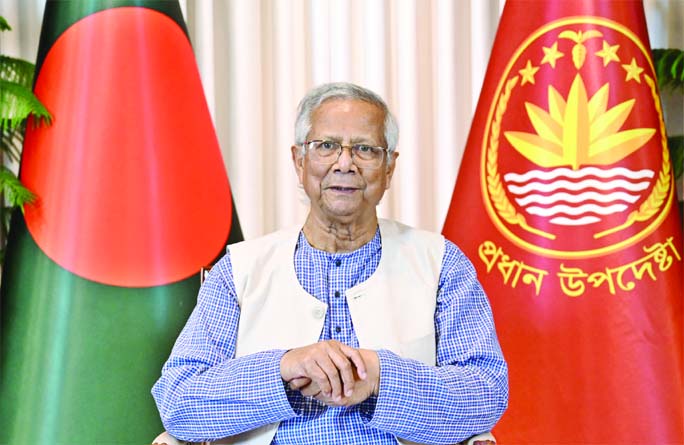
Chief Adviser Professor Muhammad Yunus on Tuesday urged citizens to take part in both the general election and the referendum, describing the moment as historic and decisive for shaping Bangladesh’s future.
“Some days in a nation’s life carry far-reaching significance, when the future course of the state, the nature of democracy and the fate of coming generations are determined,” he said.
“The day after tomorrow is such a moment. Two votes will take place — one to elect a new government and another to determine the future structure of our beloved Bangladesh through a referendum.”
Professor Yunus made the remarks in a televised address to the nation on the occasion of the 13th Jatiya Sangsad election and the referendum on implementing the July National Charter, scheduled for February 12. Bangladesh Television (BTV) and Bangladesh Betar aired the speech simultaneously.
At the outset, he extended greetings to people of all ages and professions and paid deep tribute to the martyrs of the Liberation War and the July Mass Uprising, saying their sacrifices made both the election and the referendum possible.
He said Bangladesh is now passing through a critical democratic transition after a prolonged struggle against authoritarianism, noting that the nation remains forever indebted to ordinary citizens — particularly the July fighters — whose sacrifices paved the way for the polls and the referendum.
With the official campaign period having ended, the Chief Adviser said the time had come for citizens to make their decision.
He expressed satisfaction that the election campaign had been comparatively peaceful, unlike many past elections.
“Despite differences in views and ideologies, political parties have shown restraint, candidates have acted responsibly and the public has remained vigilant,” he said, adding that such an environment was the result of collective responsibility.
He thanked political parties, candidates, voters, the Election Commission, civil society members, media professionals, law-enforcement agencies and the administration for their combined efforts in reaching the threshold of the polls in a conducive atmosphere.
At the same time, he expressed sorrow over several violent incidents since the announcement of the election schedule, which claimed lives.
“Any loss of life in the democratic process is unacceptable in a civilized state,” he said, noting that such violence had shaken the nation’s conscience.
Highlighting participation, Professor Yunus said a record 51 political parties are contesting the election, with more than 2,000 candidates — including independents — competing, a scale rarely seen in previous national polls.
He described the election as the first national vote following a mass uprising, calling it a constitutional expression of people’s awakening against years of discrimination, deprivation and injustice.
“The demands once raised on the streets will now be voiced through ballots,” he said, terming the election a historic milestone in Bangladesh’s democratic journey.
Through the election and referendum, he said, citizens would decide whether the country moves toward a just, accountable and discrimination-free state or returns to an old, power-centric cycle.
He urged candidates to place national interest above personal or party considerations and to accept both victory and defeat as integral parts of democracy. He also called on all to work together after the polls to build a new, inclusive and democratic Bangladesh.
Addressing young and women voters, Professor Yunus said they had been deprived of genuine voting opportunities for the past 17 years, growing up in a system where ballots existed without true participation.
Despite prolonged deprivation, he said, they did not surrender hope, but carried the dream of a new Bangladesh through movements and protests, culminating in the July mass uprising that altered the course of history.
He highlighted women’s role from the Liberation War to recent democratic movements, noting their leadership in the July uprising and their contribution to the economy, foreign exchange earnings and social transformation.
“You have fought both at home and on the streets, safeguarding future generations, yet you were long denied a voice in state decisions. This election marks a new beginning for you,” he said.
Turning to youth, he said their vote would be their first genuine political statement, urging them to go to polling centres without fear.
“Your single vote will not only choose a government but answer 17 years of silence and reshape the nation,” he added.
Professor Yunus said extensive preparations had been made to ensure a free, fair, neutral and peaceful election, including record deployment of law-enforcement personnel and armed forces with magisterial powers.
He said technology was being used on an unprecedented scale — including CCTV, body-worn cameras, drones and dog squads — to ensure voters could cast ballots safely and with dignity.
For the first time, he noted, expatriate Bangladeshis have been given the opportunity to vote, expanding democratic participation and drawing international interest.
Postal voting facilities have also been extended to officials on duty, law-enforcement personnel and eligible citizens in custody.
“The right to vote is a constitutional right, not a favour,” he said, adding that ensuring a free and fair election is a shared responsibility of the state and citizens.
He urged political parties to issue clear instructions to prevent violence, intimidation, vote manipulation or disinformation, warning that the state would not tolerate such actions.
Cautioning against rumours and deliberate misinformation, he advised citizens to verify information and use the “Election Bondhu” hotline (333).
He dismissed claims that the interim government would retain power as baseless propaganda, assuring a swift transfer of authority to the elected government.
On the referendum, Professor Yunus said the July National Charter was not a party manifesto but the outcome of nine months of discussions involving over 30 political parties through the National Consensus Commission.
Describing the charter as a historic roadmap reflecting the spirit of the mass uprising, he said reforms require active public participation.
The referendum, he added, allows citizens to directly shape the country’s reform path, marking a new milestone in national history.
“Every vote will lay the foundation of the future state system and affect generations to come,” he said, calling on citizens to participate actively.
Urging peaceful and responsible participation, he said, “Let us go to polling centres with hope, not fear; unity, not division.”
He expressed confidence that a credible election and referendum would prove Bangladesh’s ability to determine its own future.
Following the polls, he said, the elected government would assume office promptly and the interim government would conclude its responsibilities with pride.
Calling on citizens to vote with their families in a festive spirit, Professor Yunus said, “The key to building a new Bangladesh is in your hands. Use it wisely.”
He expressed hope that election day would mark the birth of a new Bangladesh.