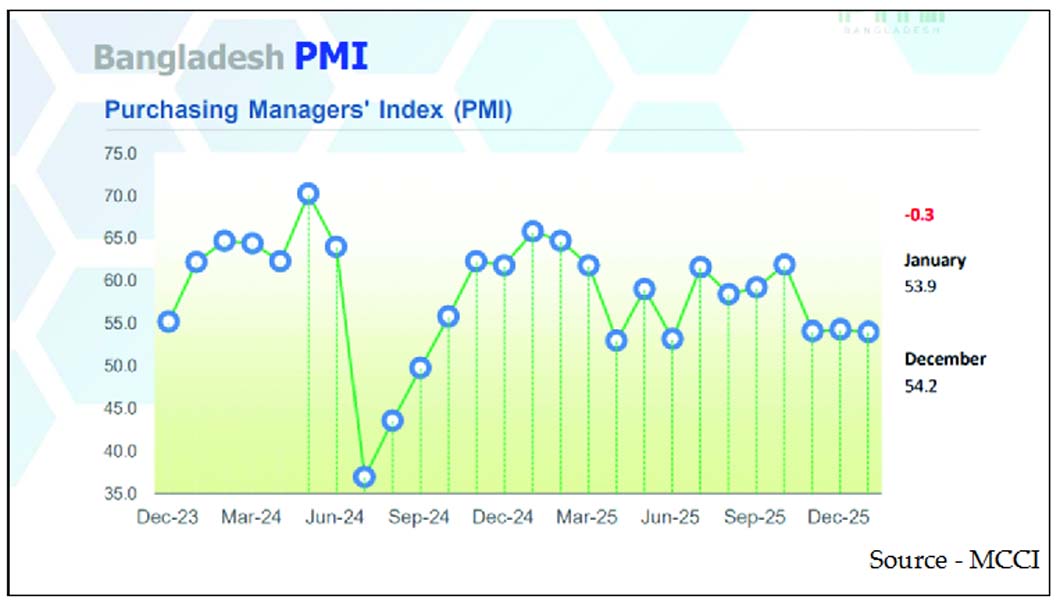
PMI slipped by 0.3 point to 53.9 in Jan, lowest since June: MCCI

Business Report :
Bangladesh’s economy may have expanded at its slowest pace in January 2026 compared to the last seven months, as the latest Bangladesh Purchasing Managers’ Index (PMI) showed a marginal easing in momentum amid softer manufacturing exports.
The PMI is a forward-looking indicator used globally to gauge economic direction. A reading above 50 indicates expansion, while a reading below 50 indicates contraction.
In January, PMI slipped by 0.3 points from the previous month to 53.9, signalling a moderation in the pace of expansion, according to the latest report by the Metropolitan Chamber of Commerce and Industry, Dhaka (MCCI), and Policy Exchange Bangladesh (PEB).
For comparison, the PMI stood at 53.1 in June 2025.
Overall economic activity remained in expansion territory, supported by continued growth in agriculture, manufacturing and services.
The agriculture sector recorded its fifth consecutive month of expansion, although growth slowed. Expansion continued in new business and business activity, while employment and input costs contracted. Order backlogs also remained in contraction, albeit at a slower pace, indicating subdued demand pressures.
Manufacturing stayed in expansion for the 17th straight month, though growth eased compared to December. New orders, factory output, imports, input prices and supplier deliveries all expanded.
However, new exports, input purchases, finished goods inventories and employment contracted, pointing to cautious order placement and weakness in global supply chains. Order backlogs returned to expansion during the month. “Overall, the latest PMI readings indicate that the economy experienced a slower expansion, with weak global supply chain recovery and cautious order placement weighing heavily on manufacturing exports,” said M Masrur Reaz, chairman and chief executive officer of PEB.
He added that the agriculture sector also showed signs of slowdown after the late autumn paddy harvests.
Construction contracted in December, but expanded again in January. The rebound came with gains in new business, construction activity and input costs. Employment and order backlogs, however, continued to contract.
The services sector marked its 16th consecutive month of expansion, with growth accelerating. All key indicators, new business, business activity, employment, input costs and order backlogs, remained in expansion territory.
Looking ahead, the future business index indicated faster expansion across agriculture, manufacturing, construction and services, reflecting improved business sentiment.