Election 2026: Rising concern on large-scale vehicle requisition
City Desk :
Large-scale requisitioning of vehicles across Bangladesh due to the 13th National Parliamentary Election and the referendum has activated concern among vehicle owners.
Vehicle owners fear that they will not receive proper compensation despite legal provisions requiring payment. Although the law allows authorities to requisition vehicles for election-related duties, owners and drivers have complained that during previous elections compensation was either delayed or not paid at all. Police officials, however, say that owners will be paid rent along with fuel and staff costs to the best of the authorities’ ability, while the Election Commission (EC) has directed that all requisitions be carried out strictly in line with regulations.
During national elections and other major occasions, buses, trucks, microbuses, private cars, and other vehicles are routinely requisitioned. Under the law, compensation is to be paid to owners, covering rent, fuel expenses, drivers’ meals, and toll charges. However, owners and drivers have alleged that during several past elections these costs were not fully covered.
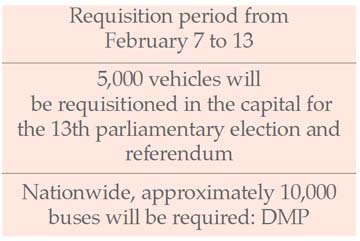
According to sources at the Dhaka Metropolitan Police (DMP) and bus owners’ associations, around 5,000 vehicles of various types will be requisitioned in the capital for the 13th parliamentary election and referendum. Nationwide, approximately 10,000 buses will be required. Officials said the demand has already been communicated during meetings between the traffic department and bus owners’ associations.
Zubayer Masud, spokesperson and office secretary of the Dhaka Road Transport Association said the traffic department informed association leaders that 10,000 buses would be needed across the country. In line with this demand, buses have been supplied since Saturday, he said, adding that the requisition period will run from February 7 to 13.
Masud said bus owners were verbally assured by police that during the requisition period they would receive at least Tk2, 000 per day per bus to help cover bank installments, along with fuel costs and meals for drivers. Meanwhile, concern has grown among vehicle owners and drivers over the requisitioning process, particularly over whether privately owned vehicles such as private cars and microbuses can also be requisitioned. Police maintain that under the law, any type of vehicle may be requisitioned if required.
At Fulbaria in Gulistan, Dhaka, Manik Dewan, supervisor of D-Link Paribahan operating on the Dhaka-Dhamrai route, said that of the company’s 73 buses, 60 have been requisitioned. Requisitioning began on Saturday, with some buses already taken, he said, adding that the vehicles will be used until February 10 and held until February 13.
Nearby, at the bus stop of Shubhojatra Paribahan, which operates on the Dhaka-Manikganj route, around 20 buses have also been requisitioned, according to sources.
Abdur Razzak, a leguna driver from the Jurain area, said operations have already been curtailed out of fear of requisitioning, as drivers often receive little more than meals. He said documents for his own leguna have been seized for requisition and that he has been asked to make contact on February 8.
Vehicle owners have also been voicing concerns on social media, with many questioning whether privately owned vehicles can legally be requisitioned. In a Facebook group named Traffic Alert, users have been sharing queries and anxieties regarding the ongoing process.
One user, Azhar Uddin, wrote that traffic police stopped his privately owned Toyota Esquire vehicle and attempted to requisition it.
Although he avoided requisition on that occasion after a call from a senior official, police informed him that the vehicle would be requisitioned without question if found on the road again. He asked fellow users whether privately owned vehicles could legally be requisitioned.
Responding to the issue, DMP Joint Commissioner (Traffic-South) Mohammad Kamruzzaman said the DMP Ordinance authorizes police to requisition privately owned vehicles as well.
Additional Commissioner of Police (Traffic) Md Anisur Rahman told Dhaka that fuel costs for requisitioned vehicles would be borne by the police, drivers would receive subsistence allowances, and owners would be paid based on bills they submit.
He added that around 4,500 vehicles are required within the Dhaka metropolitan area for election-related duties and that most of the arrangements have already been completed.
Under Section 103-Ka of the Dhaka Metropolitan Police Ordinance, notwithstanding anything contained in any other law, the police commissioner may, by written order, requisition any vehicle for a period not exceeding seven days if required in the public interest. In such cases, the vehicle owner must be paid compensation at a prescribed rate.
Ahead of the election and referendum, the Election Commission has directed that vehicle requisitioning be conducted strictly in accordance with regulations. It instructed that compensation be determined based on locally prevailing rates or fares and paid accordingly to owners. These directives have been communicated to the police commissioner following a letter from the DMP.
A related directive has also been issued by Md Shahidul Islam, senior assistant secretary of the EC’s Election Management and Coordination Wing.
In line with the Representation of the People Order, 1972, and the Dhaka Metropolitan Police Ordinance, 1976, authorities have been instructed to make necessary arrangements for requisitioning vehicles for mobile duty, patrol duty, reserve forces, transportation of election materials, transport of security forces, and other election-related purposes.