
Shocking Corruption Revealed: Crores embezzled in Agrani Bank’s overseas subsidiaries
Reza Mahmud :
A sensational picture of irregularities and fund misappropriation over many years has emerged from the internal audit of two overseas subsidiaries of the state-owned Agrani Bank PLC: Agrani Exchange House Private Limited in Singapore and Agrani Remittance House Sdn. Bhd. in Malaysia.
Auditors, reviewing more than seven years of financial accounts (from July 1, 2017, to December 31, 2024), found clear evidence of fund embezzlement, policy violations, abuse of authority, “pocket banking,” and personal enrichment by responsible officials.
This audit, conducted under the initiative of the Audit and Inspection Division-2 at the head office in Dhaka, has recently been submitted to the Managing Director and CEO of Agrani Bank.
According to the report, these irregularities are “completely contrary to banking regulations, financial discipline, and good governance,” many of which constitute direct criminal offenses.
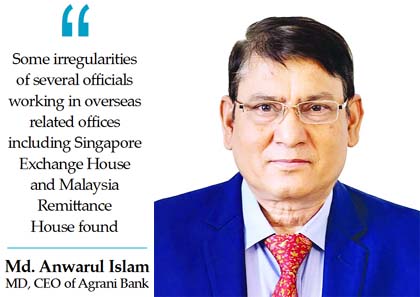
When contacted, Md. Anwarul Islam, Managing Director and CEO of the Agrani Bank told The New Nation on Saturday, “We have got some irregularities of several officials working in overseas related offices including Singapore Exchange House and Malaysia
Remittance House.
We have taken strict action against the concern officials.”
The bank has realised money from several of those officials except one. “We have gave him deadline of March 15 for return the money they have embazzled,” the MD and CEO said.
He said, “No one to be spared from punitive actions for these corruptions.”
Sources said, the concern officials have done such corruptions for long managing several higher officials.
A team of Bangladesh Bank officials are due to visit Agrani Bank today (Sunday) for taking actions against the irregularities.
Singapore Exchange House: Serious Irregularities
The audit report identifies several serious issues at Agrani Exchange House Private Limited in Singapore, involving funds totaling SGD 106,404.92. Of this, only SGD 47,074 has been recovered, leaving an outstanding amount of SGD 59,303.78, representing a direct loss to the bank.
Direct allegations have been made against both former and current top officials. Former CEO and Director Abu Suja Md. Shariful Islam is accused of embezzling over SGD 63,720.
According to auditors, he failed to deposit funds collected from expatriates into the bank, instead using them personally, and engaged in illegal transactions in collaboration with hawala networks.
Although payments were made to remittance beneficiaries’ accounts, the bank suffered substantial losses due to delayed reimbursement of cover funds.
The report further states that he failed to reconcile cash accounts when returning to the country.
Even when the bank sent him back to Singapore at its expense to settle the discrepancies, he could not account for the missing funds.
Auditors described the lack of punitive action against him over such a long period as “unprecedented and alarming.”
Current CEO and Director Mir Bayezid Hossain is held responsible for irregularities totaling SGD 16,585. He is accused of concealing the former CEO’s corruption and hiding accurate information.
Auditors note that undeclared income, unauthorized expenditures, personal use of corporate funds, and “pocket banking” were all part of these illegal activities, which constitute punishable offenses.
Malaysia Remittance House: Widespread Violations At Agrani Remittance House Sdn. Bhd. in Malaysia, the scale of irregularities is even more severe. Seven key violations alone accounted for MYR 124,168.37, of which MYR 46,641 was initially recovered. The remaining funds were later paid under pressure from authorities.
Current CEO and Director Sultan Ahmed is solely responsible for MYR 52,943 in irregularities. Former CEOs Khaled Morshed Rizvi, Lutfor Rahman, and Wali Ullah are implicated in MYR 16,584, MYR 6,000, and MYR 2,000 respectively.
The audit revealed a pattern of organized plunder, including premature family relocation to Malaysia in violation of employment rules, receipt of medical and child education allowances without authorization, payment of personal vehicle fuel and tolls from corporate funds, fake documentation for travel expenses, and pocketing of shop rent.
Some funds were later recovered, but keeping bank money for personal use remains a criminal offense.
Additionally, irregularities were found in branch inspection travel, unauthorized training expenses, and extra allowances for board meeting attendance.
For example, over MYR 30,000 was illicitly claimed under board meeting allowances alone.
These corrupt CEOs have severely damaged Agrani Bank’s reputation both at home and abroad.
An unscrupulous network within the bank has historically obstructed audit attempts at these subsidiaries.
Audits were only possible after intervention by the current management and chairman on August 5, yet many of these corrupt actors remain unpunished for unknown reasons.
Questioning Governance and Accountability
Experts note that such irregularities in state-owned bank subsidiaries abroad indicate extremely weak oversight and internal control systems. Despite long-term misconduct, the management failed to take effective measures.
Reports of extensive corruption and misappropriation under former MD Shamsul Islam’s patronage were widely circulated, yet the bank remained largely unaware.
Allegations included sending favored personnel abroad to siphon large sums of money without adhering to rules and policies.
Following the audit, authorities have instructed the recovery of outstanding funds from responsible individuals.
Economists warn that such misconduct in state-run expatriate fund management tarnishes the reputation of the country’s remittance sector.
The key question now is whether the audit recommendations will be implemented effectively, or if, as in the past, these reports will remain filed away.
What Needs to Be Done
The audit recommends immediate punitive action against those responsible, recovery of outstanding funds, and criminal investigation to restore confidence in the banking sector.
Experts stress that beyond administrative measures, investigations under the Money Laundering Prevention Act, asset seizure, and exemplary punishment are essential.
This report serves as a test for the governance of state-owned banks. If it is merely archived, it will provide silent protection for offenders.
If effective action is taken, it will set an important precedent for good governance and accountability.
The irregularities at Agrani Bank’s subsidiaries in Singapore and Malaysia reflect not only financial corruption but also the fragility of internal governance in state institutions. The internal audit has unveiled this picture.
The question remains-will this information stay confined to the report, or will it pave the way for accountability, justice, and reform? For the integrity of the country’s remittance sector and public trust in banking, the latter path is the only acceptable option.