
News Analysis: BNP and Jamaat Manifestos Lay Competing Visions as Election Battle Sharpens
Editorial Desk :
As Bangladesh moves closer to a decisive national election, the release of manifestos by the Bangladesh Nationalist Party (BNP) and Bangladesh Jamaat-e-Islami has clarified the ideological and policy choices now facing voters.
While both opposition forces pledge reform, justice, and economic revival, their documents reveal sharply different approaches to governance, welfare, and the future direction of the state.
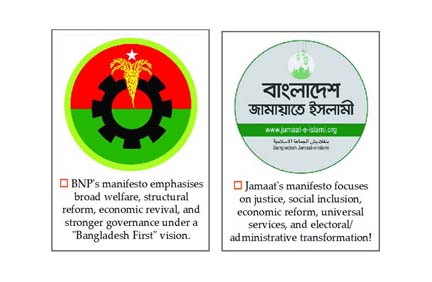
The BNP’s manifesto positions itself as a broad “restoration project,” centred on reviving democratic institutions, stabilising the economy, and rebuilding public trust.
Framed around welfare guarantees such as family and farmer support cards, healthcare expansion, education reform, and youth employment, the party presents a technocratic and market-friendly vision backed by targeted social protection.
It also promises constitutional and institutional reforms, tighter anti-corruption measures, and a rebalancing of executive power, portraying its programme as a new social contract between state and citizen.
Unveiled under the political stewardship of Tarique Rahman, the BNP manifesto places strong emphasis on electoral credibility and civil liberties, arguing that economic recovery is inseparable from democratic legitimacy.
The party also outlines a clearer foreign policy posture than in previous campaigns, highlighting balanced diplomacy, national sovereignty, and regional cooperation as pillars of its external strategy.
By contrast, Jamaat-e-Islami’s manifesto adopts a justice-centred and socially conservative tone, placing greater stress on moral governance, institutional restructuring, and universal access to basic services.
Its proposals include electoral reform, stronger accountability mechanisms, integrated social security systems, and explicit commitments to women’s participation and minority protection.
Jamaat also prioritises banking reform, cost-of-living controls, and workforce development, presenting itself as a force for ethical administration and social equity.
While both parties converge on headline goals – fighting corruption, creating jobs, and expanding healthcare and education – their underlying philosophies diverge.
BNP advances a welfare-supported, growth-oriented model rooted in pluralist democracy and private-sector dynamism.
Jamaat, meanwhile, foregrounds justice and social cohesion through a values-based framework, with less emphasis on foreign policy and more on domestic moral and institutional renewal.
Political analysts note that BNP’s manifesto is broader in scope and more explicit about macro-economic ambition, while Jamaat’s document is more granular on social reform and governance ethics.
However, critics of both point to a familiar gap between promise and implementation, observing that neither manifesto fully details funding mechanisms or timelines for delivery.
The comparison also carries strategic implications. BNP appears to be courting urban voters, youth, and business communities with its economic roadmap, while Jamaat seeks to consolidate support among socially conservative constituencies and those disillusioned with elite politics.
As campaigning intensifies, this contrast may shape alliance calculations and voter mobilisation across both rural and metropolitan areas.
Ultimately, the two manifestos reflect competing visions for Bangladesh’s future: one anchored in democratic restoration and economic modernisation, the other in justice-driven reform and social discipline.
For voters, the choice will hinge not only on policy pledges but on credibility – which party they believe can translate manifesto commitments into meaningful change on the ground.