Inqilab Mancha blocks Shahbagh after police clash, traffic comes to a standstill

Staff Reporter :
Leaders and activists of Inqilab Mancha blocked the Shahbagh intersection in Dhaka on Friday evening following a clash with police, bringing traffic in one of the capital’s busiest areas to a complete halt.
The blockade began around 5:15pm when protesters marched from the Raju Memorial Sculpture on the Dhaka University campus and took position at Shahbagh.
The move followed hours of tension and confrontations earlier in the afternoon as demonstrators attempted to march towards the State Guest House Jamuna, the official residence of the chief adviser, demanding justice for the killing of Inqilab Mancha spokesperson Sharif Osman Hadi.
Clashes first erupted at around 3:45pm near the Hotel InterContinental intersection, where police had set up barricades.
Protesters had been staging a sit-in since Thursday afternoon in two groups—one in front of Jamuna and another near the hotel—calling for an impartial investigation into Hadi’s killing under United Nations supervision.
According to witnesses, tensions escalated when
a group of demonstrators tried to move from the InterContinental area towards Jamuna and were stopped by police. A scuffle followed, after which protesters attempted to break through the barricades.
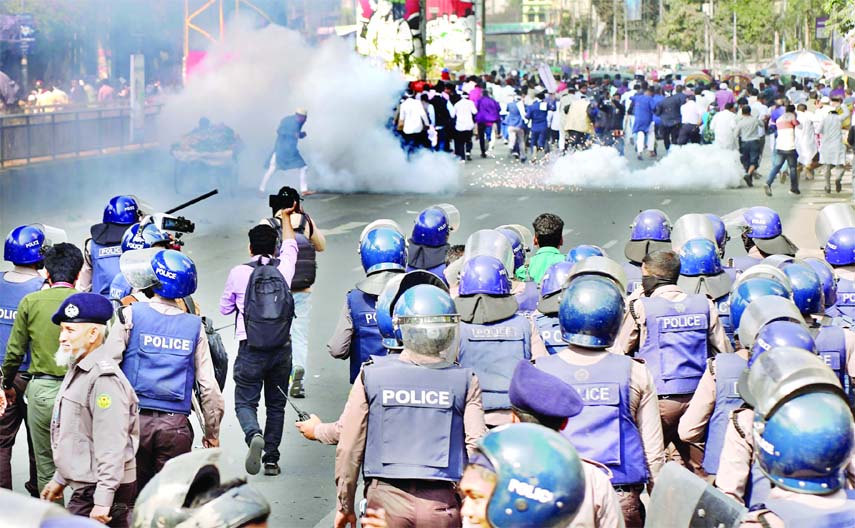
Police initially used water cannons and later deployed sound grenades, tear gas shells and batons to disperse the crowd. Protesters responded by throwing bottles and bricks at law enforcement officers.
Several people were injured in the clashes, including Inqilab Mancha Member Secretary Abdullah Al Jaber and the platform’s Dhaka University spokesperson and Dhaka University Central Students’ Union (DUCSU) leader Fatima Tasnim Jhuma.
They were taken to Dhaka Medical College Hospital for treatment.
Hospital sources said at least 23 people received treatment for injuries. Doctors on duty confirmed that none of the injured had sustained gunshot wounds.
Police said the use of force was necessary to prevent protesters from breaching security around Jamuna.
Dhaka Metropolitan Police Commissioner Sheikh Md Sazzat Ali said demonstrators broke police barricades and attempted to surround the guest house, while a section of the crowd climbed onto a water cannon and tried to damage it.
“In the interest of public order and security, police were compelled to act,” he said.
After the clash, protesters regrouped. Around 4:30pm, Nasiruddin Patwary, a candidate of the 11-party Election Alliance for the Dhaka-8 constituency, arrived at the InterContinental area.
He and others then led a protest march towards Shahbagh, where demonstrators eventually blocked the intersection.
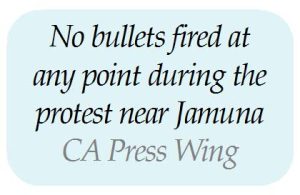
The government later said law enforcement personnel did not use any lethal weapons and that no shots were fired.
Authorities noted that all forms of rallies, marches and public gatherings are prohibited in and around Jamuna to ensure public order and the chief adviser’s security.
In a statement, the government reiterated its commitment to ensuring justice for the killing of Sharif Osman Hadi and said it was closely examining the legal framework for conducting an investigation under the United Nations. It added that an official letter would be sent to the relevant UN body on Sunday.
Rejecting allegations of excessive use of force, the government urged all parties to exercise restraint, particularly ahead of the upcoming national election, which it described as a critical milestone in the country’s democratic journey.
It called on citizens and political groups to act responsibly to ensure a peaceful, inclusive and credible electoral process as both domestic and international attention remains focused on Bangladesh.