National Logistics Policy: Urgent implementation needed to face coming challenges
Business Report :
The urgent ratification and implementation of the National Logistics Policy (NLP) 2025 is necessary enhancing trade competitiveness and support Bangladesh’s goal of reaching a US$ 760 billion GDP by 2030, said Business leaders and experts.
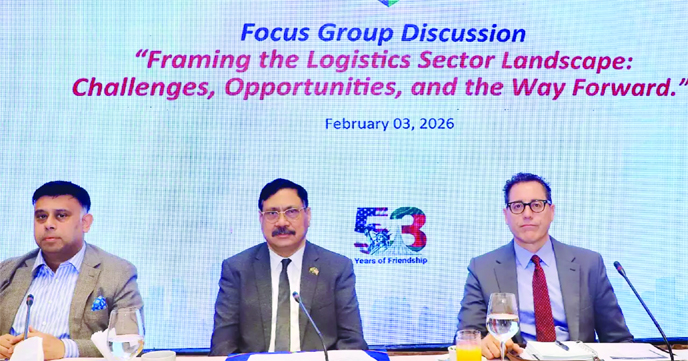
The call was made during a Focus Group Discussion titled “Framing the Logistics Sector Landscape: Challenges, Opportunities, and the Way Forward,” organized by the American Chamber of Commerce in Bangladesh (AmCham) at a city hotel on Tuesday.
The session brought together key stakeholders from the RMG, shipping, aviation, and development sectors, along with officials from the U.S. Embassy, Dhaka.
Syed Ershad Ahmed, President of AmCham Bangladesh at the event , said efficient logistics systems are essential for sustaining supply chains, supporting economic growth, and ensuring the continuity of everyday life.
The global logistics landscape is being rapidly reshaped by forces such as AI and automation, de-carbonization and fuel transitions, geopolitics, regionalization, and supply chain resilience, and stressed the need to bridge existing knowledge and capacity gaps to better support the country’s growing trade and investment needs, he expressed.
Highlighting the economic impact of the sector, Dr. M. Masrur Reaz, Chairman of Policy Exchange Bangladesh, noted that a mere 1per cent reduction in logistics costs could increase national exports by approximately 7per cent.
He pointed out critical structural risks, including a heavy 70per cent reliance on the Dhaka-Chattogram corridor and the absence of a central logistics authority.
Dr. Reaz identified the Matarbari Deep Sea Port, Bay Container Terminal, and the third terminal of Hazrat Shahjalal International Airport as pivotal opportunities for long-term capacity building.
Regarding air logistics, Mahbubul Anam, Managing Director of CF Global, revealed that logistics costs at Dhaka airport are 20-25per cent higher than road transport.
He stressed the need for cost rationalization and noted that while clearance facilities exist for the EU, direct cargo flights and cargo clearance for the United States remain pending.
Nusrat Nahid Babi, Senior Transport Specialist, South Asia, The World Bank, said that Bangladesh’s logistics reform momentum since 2022 must be reaffirmed by the new government through clear priorities and high-level consensus.
She outlined a phased reform agenda structured around five thematic pillars: policy and procedural simplification; multimodal logistics infrastructure and connectivity; skills and institutional capacity development; supply-chain digitalization; and investment in logistics.
Md. Moinul Huq, Citi Country Officer, Bangladesh Citibank, N.A., highlighted the urgent need for customs authorities to operationalise provisions of the Customs Act 2023 by clearly defining electronic document submission and payment modalities.
Participants expressed concern about the heavy dependence on RMG exports, slow progress in new infrastructure development, and poor implementation of electronic documentation despite the presence of enabling policies.