Rooppur Nuclear Power Plant: Comprehensive safety system test successfully completed

Pabna Correspondent :
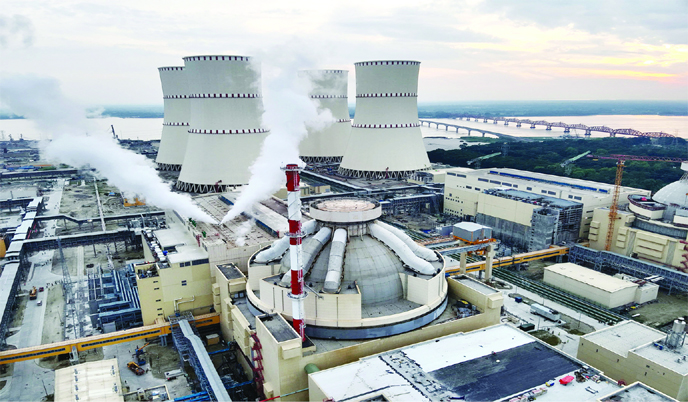
The Comprehensive Safety System Test (CSST) has been successfully completed at the Rooppur Nuclear Power Plant, Bangladesh’s first nuclear power project. Through this test, the final safety preparedness of Unit-1 prior to nuclear fuel loading was verified.
Dr. Zahedul Hasan, Managing Director of Nuclear Power Plant Company Bangladesh Limited, said on Wednesday (4 February) that the test successfully validated the performance of the reactor building’s containment integrity, internal flooding control, fuel pool safety, and fully automated safety systems under both design-basis and extended conditions.
Regarding containment and the water-barrier principle, Dr. Zahedul Hasan explained that the core technical objective of the test was to ensure full containment and hydraulic isolation. During the test, two key conditions were strictly monitored and verified:
1.Even under high flow rates and prolonged sprinkler operation, water would not penetrate protected zones inside the containment; and
2. Any water accumulated inside the containment would not be released into the external environment.
Through this process, the effectiveness of the containment walls, sealing joints, penetration points, drainage isolation, and water-tight barrier systems was confirmed.
On the sprinkler system and internal flooding test, he said that the sprinkler system installed at the top of the reactor hall was operated continuously for 12 hours at the design flow rate and specified pressure.
This created controlled internal flooding, realistically simulating extreme accident and fire-suppression conditions. The test enabled analysis of the system’s mechanical durability over an extended period, nozzle performance, piping stress, and the behavior of support structures.
Regarding verification of the fuel pool safety system, the Managing Director noted that several critical technical parameters of the spent fuel pool safety system were monitored during the comprehensive test. These included control of the fuel pool water level, temperature limits, heat removal capacity, and continuous operation of the cooling system. The test confirmed that the fuel pool remains within safe operational limits even under internal flooding conditions.
Concerning automated safety systems and control logic, it was learned that a key technical aspect of the test was verification of the fully automated safety and control systems.
Based on sensor-generated signals, sprinkler actuation, valve operations, alarms, interlocks, and monitoring systems were activated automatically according to predefined control logic, without any human intervention. This confirmed the successful implementation of redundancy, diversity, and fault-tolerance principles.
Officials working in the water management and environmental protection division stated that the volume of water used in the test, flow rates, and collection and discharge systems were strictly controlled and monitored. This ensured that all test-related water usage remained confined within the containment and posed no environmental risk.
According to the concerned officials, the entire test was supervised by nuclear safety, operations, and engineering teams through real-time data monitoring and analysis. The Comprehensive Safety System Test was successfully completed in accordance with international nuclear safety standards and design requirements.
According to the NPCBL Managing Director, following the successful completion of the Cold Run and Hot Run, this test is considered a highly significant technical milestone in the commissioning phase of the Rooppur Nuclear Power Plant.