
Experts call for nationwide movement against illegal fishing nets
Staff Reporter
Experts on Tuesday called for a nationwide social movement against illegal fishing nets, warning that the unchecked use of destructive nets is severely damaging fish populations, breeding grounds, and aquatic biodiversity across the country.
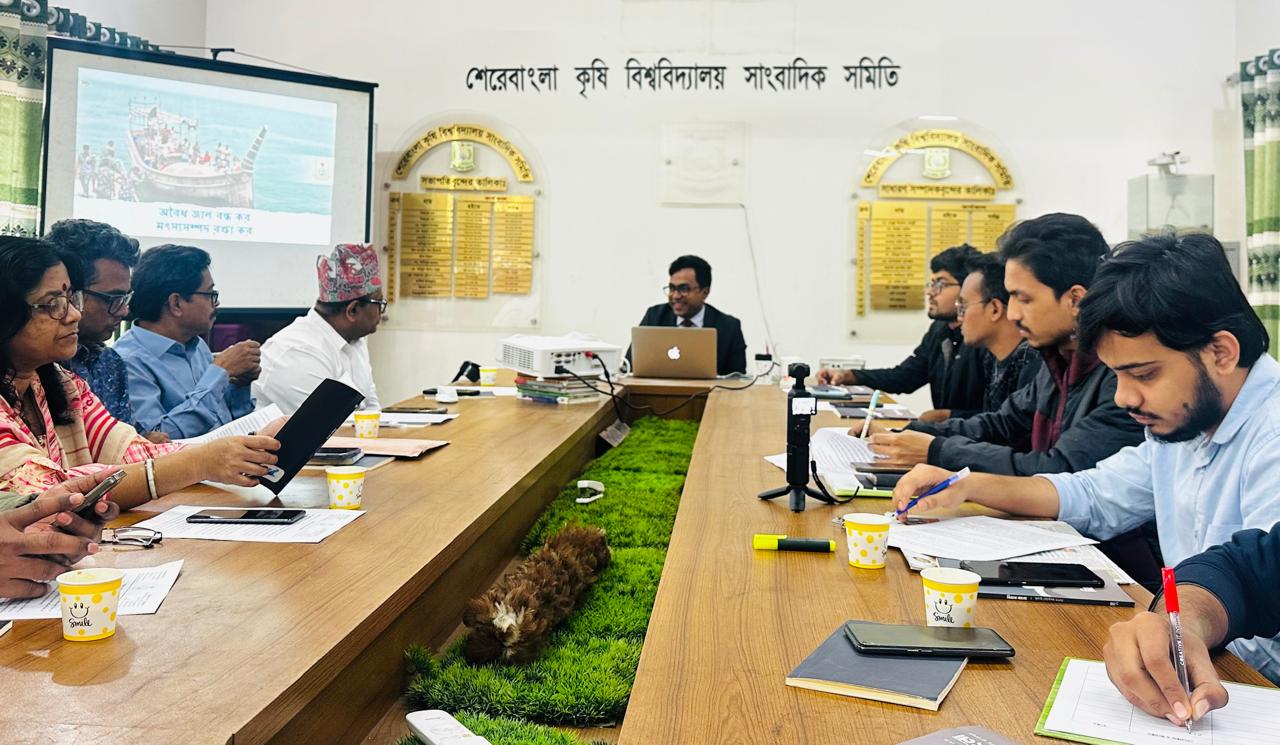
The call was made at a programme held at the office of the Sher-e-Bangla Agricultural University Journalists’ Association under the slogan, “Stop Illegal Nets, Protect Fish Resources.”
The event was chaired by the association’s president and Daily Samakal correspondent Kamrul Islam Sajal. The keynote paper was presented by Mir Mohammad Ali, a teacher and researcher from the Faculty of Fisheries and Marine Science at the university.
In his presentation, Mir Mohammad Ali said Bangladesh’s rivers, canals, wetlands, haors, baors, and coastal waters are major sources of national fish resources.
Around 12 percent of the country’s population depends directly or indirectly on fisheries for their livelihood, while the sector supplies nearly 60 percent of daily animal protein.
Fisheries also contribute 1.53 percent to national GDP and over 22 percent to agricultural GDP.
He warned that the widespread use of illegal and destructive nets such as current nets, China duari, behundi, khuta, and mosquito nets is rapidly destroying fish fry and brood fish. These nets are damaging natural breeding grounds and pushing aquatic biodiversity toward collapse.
Referring to hilsa production, Mir Mohammad Ali said about 700,000 fishermen in coastal areas depend directly on hilsa, while around 2.5 million people depend on it indirectly.
According to government data, hilsa production fell by 7.33 percent in the 2023–24 fiscal year, after a nearly 25 percent increase in 2016–17.
He identified uncontrolled use of illegal nets in coastal areas as one of the main reasons behind this decline.
He explained that these nets block breeding hilsa from entering rivers. Even after spawning, many fish and other aquatic species are destroyed inside the nets.
Although the government has introduced measures such as a 22-day fishing ban, illegal nets are still widely used, and the killing of brood hilsa and jatka continues.
“Administrative action alone is not enough,” he said. “We need social awareness and citizen-led initiatives alongside government efforts.”
Mir Mohammad Ali called on the government, media professionals, researchers, students, fishing communities, environmentalists, and conscious citizens to build a national social movement to stop the use of illegal nets and restore ecological balance in rivers and wetlands.
He announced a 10-point program, including public awareness campaigns, media outreach, alternative livelihoods for fishermen, stricter law enforcement, control of net manufacturers and sellers, research and innovation, education-based programmes, local fish protection committees, joint government–civil society initiatives, and observance of an “Anti-Illegal Net Week” with a hotline and annual action plan.
Speaking at the event, senior journalist Nikhil Bhadra of Kaler Kantho said many government initiatives fail due to lack of public participation, but a social movement could gradually change the situation.
Parliament News BD editor Shakila Parvin said society must unite to stop the political protection that allows destruction of aquatic resources.
River Bangla editor Faisal Ahmed emphasized taking the movement to grassroots levels so citizens can question political leaders and prevent illegal net use.
Environmental activist and Abashon News editor Ibnul Sayeed Rana said it was encouraging to see a university teacher lead such an initiative, as students are future policymakers and administrators.
During the question-and-answer session, Mir Mohammad Ali said reducing illegal nets in estuaries and coastal areas would allow hilsa to enter rivers, protect jatka, increase production, and eventually help reduce hilsa prices.
He also noted that declining river fish stocks are forcing many small-scale fishermen to work as labourers on sea trawlers, where they lose control over their livelihoods.
He said the movement is based on long-term experience and must grow through collective participation to become a true national social movement.
Journalists from Desh Rupantor, Bangladesh Pratidin, Channel 24, The Dhaka Diary, Jago News 24, The New Nation, and other media outlets were present at the programme.