
Election month begins as campaigning turns fierce
Abu Jakir :
With just 10 days remaining before the country’s much-anticipated general election and referendum on February 12, the official start of the election month has been marked by an alarming surge in political violence, clashes between rival party activists and increasingly incendiary campaign rhetoric across the country.
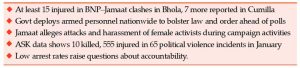
As candidates intensify door-to-door campaigning and hold rallies in constituencies nationwide, confrontations between supporters of competing parties have become more frequent and deadlier, raising concerns about the overall security environment ahead of the 13th Jatiya Sangsad election.
Party leaders, meanwhile, have stepped up fiery speeches and sharp verbal attacks, further heightening tensions on the ground.
Addressing a large election rally in Cumilla’s Chauddagram upazila on Saturday morning, Bangladesh Jamaat-e-Islami Ameer Shafiqur Rahman struck a defiant tone, rejecting what he described as authoritarianism and corruption in future governance.
“We will not accept any form of domination in tomorrow’s Bangladesh. We do not want to see fascism again. We do not want to see a corrupt government in this country.
We want to see a humane Bangladesh,” he said while speaking as the chief guest at a public meeting held at the HJ Government Pilot High School ground.
The speech came amid fresh reports of violent clashes linked directly to electioneering. In the latest incident, at least 15 people were injured on Saturday morning in Borhanuddin upazila of Bhola as supporters of the Bangladesh Nationalist Party and Jamaat-e-Islami clashed over campaign activities.
The confrontation took place around 8:30am in Ward No. 7 of Tobgi union, in front of a residence locally known as Choukidar Bari.
According to eyewitnesses and local sources, Jamaat activists had begun distributing leaflets and campaigning in favour of the party’s electoral symbol in different parts of Tobgi union.
Tensions flared when they entered the Choukidar Bari area, where BNP activists were present.
A verbal altercation quickly escalated into violence, with both sides allegedly using sticks, spades and locally made weapons.
The Bhola incident is part of a broader pattern of intensifying political violence documented by rights groups and law enforcement agencies in recent weeks.
Besides, 7 more injued in a seperate clash between BNP and Jamaat men in Chouddogram, Cumilla on Saturday.
According to data compiled by the human rights organisation Ain o Salish Kendra (ASK), at least 10 people were killed and 555 others injured in 65 incidents of political violence between January 1 and January 28 this year.
ASK records show that in just seven days—from January 21 to January 28—four people were killed and 353 injured in 42 separate incidents.
The organisation’s data further indicate that election-related violence had been steadily rising in the months leading up to the polls, with five people killed in September, six in October, eight in November and four in December of 2025.
ASK noted that many of the incidents were directly linked to electioneering, while others were triggered by disputes over social media posts related to the election and the accompanying referendum.
Police headquarters data present a similarly grim picture. According to the police, at least 201 incidents of political violence, including four killings, were reported between December 12 and January 28 following the announcement of the election schedule.
The police data show that the violence during this period included 73 clashes between rival supporters, nine attacks on candidates, eight incidents of threats, 15 cases of intimidation, two incidents involving illegal firearms and 22 instances of obstruction during campaigning.
In addition, there were 14 attacks on party offices involving vandalism or arson, 11 blockades or protest actions, one reported attack on minorities and 42 other assorted incidents.
A review of recent media reports suggests that most violent clashes have taken place between activists of the BNP and Jamaat-e-Islami, as well as between BNP supporters and those of the National Citizen Party (NCP).
On January 28, Jamaat’s Sreebardi upazila general secretary Rezaul Karim died on the way to Mymensingh Medical College Hospital after sustaining injuries in a clash between Jamaat and BNP activists in Jhenaigati upazila of Sherpur.
The incident left dozens injured and sparked protests on several university campuses and in other districts.
Earlier, on December 24, BNP cultural wing leader Farid Sarkar, joint secretary of the Gosinga union unit of Jatiyatabadi Samajik Sangskritik Sangstha, was stabbed to death by unidentified assailants in Gazipur’s Sreepur upazila.
On January 16, Nazrul Islam, 40, was killed in Mymensingh’s Dhobaura upazila during a clash between two BNP factions over the opening of an election campaign office.
He was a supporter of independent candidate Salman Omar Rubel, who had also sought BNP nomination for the Mymensingh-1 constituency.
Another killing occurred on January 7, when BNP volunteer wing leader Azizur Rahman Musabbir was shot dead in Tejturibazar in Dhaka.
While the BNP described the murder as politically motivated, police claimed it was linked to extortion.
Some clashes have also been sparked by online activity. On January 27, at least 12 people were injured in Shariatpur’s Naria upazila following a clash between Jamaat and BNP supporters over allegations that BNP activists had campaigned for a ‘No’ vote in the referendum through social media posts.
Meanwhile, the Election Commission has reported widespread violations of the electoral code of conduct.
Between January 8 and January 28, the commission recorded 192 violations across 176 constituencies. At least 119 cases were filed, and executive magistrates imposed fines amounting to Tk 12.24 lakh.
Fresh tensions were reported on Friday afternoon in Noakhali’s Hatiya upazila, where at least 12 people were injured in clashes between BNP and NCP supporters over slogan chanting at a ferry ghat inauguration.
Following the incident, NCP-backed 11-party alliance candidate for Noakhali-6, Abdul Hannan Masud, issued a two-hour ultimatum for the arrest of the attackers, threatening to withdraw from the race.
BNP candidate Mahbubur Rahman Shamim denied the allegations, while police said the situation was under control.
Against this backdrop, Jamaat-e-Islami has renewed allegations that its activists—particularly women—are facing targeted attacks and harassment during campaign activities.
At a press conference at the party’s central office on Saturday, Jamaat Assistant Secretary General Ahsanul Mahboob Zubair said that party leaders and activists had been repeatedly attacked since the election schedule was announced, alleging that perpetrators were yet to be brought to justice.