
Environmental Pollution in Ishwardi: Rice parboiling with polythene instead of husk
Pabna Correspondent :
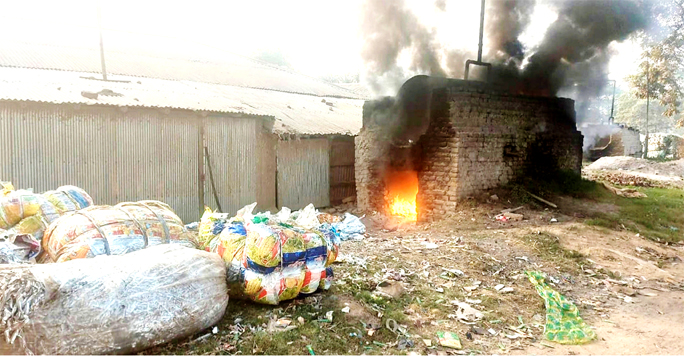
In various areas of Ishwardi, discarded polythene, old tyres, plastic and rubber shoes-sandals, and industrial waste are being openly burned for rice parboiling instead of rice husk or sawdust. As a result, the environment is being severely polluted, while cropland and public health are also being badly affected.
Large furnaces of husking mills and rice mills located beside roads and in densely populated residential areas are burning these wastes, covering the surroundings with thick black smoke. Ash flying from furnaces and boilers is damaging fruits, winter vegetables, and cultivated lands. Due to dense black smoke, vehicles and pedestrians on the roads are facing extreme difficulties, yet mill owners are ignoring the issue.
A field visit to Tetultola, Pakuria, and Joynagar areas of Dashuria Union revealed that rice is being parboiled in broad daylight by burning polythene, industrial scraps, old tyres, and plastic-rubber shoes and sandals instead of rice husk or sawdust. Mill owners said that parboiling rice with husk costs more, so they are using these wastes as fuel to reduce expenses.
Local resident Minhaj Uddin said, “It has become impossible to live inside our homes due to the intense stench of burning tyres, polythene, and rubber mixed with black smoke. Even after complaining to mill owners, they pay no attention.”
Farmer Mahabul Islam of Dashuria Tetultola area said that ash from rice mills has fallen on crops such as cucumber, maize, mustard, coriander, wheat, red spinach, and cauliflower, significantly reducing yields.
In addition, ash from burned waste is settling on nearby trees, tin roofs of houses, furniture, bedding, and clothes.
Rice mill owner Md. Abdul Khalek of Pakuria village said that since burning rice husk or sawdust is expensive, they use cheaply available polythene, industrial scraps, and old tyres for rice parboiling. He added that he collects discarded waste at low cost from Ishwardi EPZ and the Rooppur project.
Manjur Rahman, owner of Sampad Traders in Joynagar, said, “Except for me and one or two others, most mills are using waste instead of husk.
In areas where waste is being used, harmful effects on trees and plants are already visible.”
Shahid Mahmud, General Secretary of Bangladesh Poribesh Andolon (BAPA), said that such environmental pollution is continuing regularly due to administrative inaction. The black smoke produced by burning these wastes is extremely harmful to human health and is also damaging crops and vegetation.
Regarding the matter, Md. Abdul Gafur, Assistant Director of the Pabna Department of Environment, said that operations will soon be conducted against those who are secretly burning polythene, industrial waste, and old tyres for rice parboiling.