
Ex-DMP chief Habibur, 2 other former officers handed death penalty over Chankharpul killings
Staff Reporter :
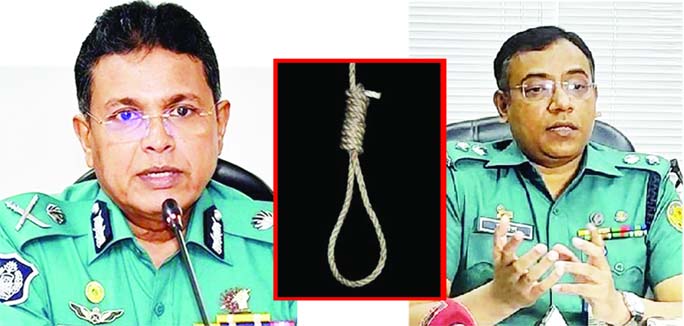
Three former senior police officials, including ex-Dhaka Metropolitan Police (DMP) commissioner Habibur Rahman, have been sentenced to death for the killing of six people in Dhaka’s Chankharpul area during the 2024 mass uprising.
The other two condemned to death are former joint commissioner Sudip Kumar Chakraborty and former additional deputy commissioner Shah Alam Mohammad Akhtarul Islam.
In the same verdict, former assistant commissioner of the Ramna zone Mohammad Imrul was sentenced to six years in prison, while former Shahbagh Police Station inspector (operations) Arshad Hossain received a four-year jail term.
Constables Sujon Hossain, Imaz Hossain and Nasirul Islam were each sentenced to three years’ imprisonment.
The verdict was delivered on Monday by a three-member bench of International Crimes Tribunal-1, headed by Justice Md Gol Golam Mortuza Mozumder.
The other members of the tribunal were Justice Md Shofiul Alam Mahmood and Judge Md Mohitul Hoque Anam Chowdhury.
Among the convicted, Arshad Hossain, Sujon Hossain, Imaz Hossain and Nasirul Islam are currently in custody.
Meanwhile, the prosecution of the International Crimes Tribunal (ICT) has expressed dissatisfaction with the verdict in a crime against humanity case over the killing of protesters in the capital’s Chankharpul area on 5 August 2024 and announced plans to appeal seeking tougher punishment.
ICT Chief Prosecutor Mohammad Tajul Islam made the remarks at a press briefing on Monday, shortly after the tribunal delivered its verdict.
He said that during the “March to Dhaka” programme on 5 August 2024, police indiscriminately opened fire on freedom-seeking students and members of the public as they advanced through the Chankharpul area, leaving six people dead.
A case was subsequently filed over the incident, and the charges against the accused were proven in court.
While the tribunal sentenced three accused to death, those who directly fired shots some of whom were seen doing so in video footage and were carrying rifles without authorised issuance received comparatively lighter sentences.
One was sentenced to six years’ imprisonment, another to four years, and three constables to three years each.
“We believe these sentences are not just,” the chief prosecutor said. He added that although court orders must be respected, the prosecution would challenge the lighter sentences.
“As there is an Appellate Division, we will file an appeal on behalf of the prosecution after receiving the full verdict and reviewing it thoroughly.”
Tajul Islam said the lighter sentences were inconsistent with justice, given the loss of young lives during the July uprising.
“We believe the death sentences given to the three senior officers are appropriate, but the punishment awarded to those who directly fired needs to be reviewed,” he said.
Responding to a question on whether the prosecution would seek the death penalty for all five accused, he said capital punishment would be sought for each of them.
“During the July Uprising, thousands of rounds were fired, resulting in 1,400 martyrs and thousands of injured. In crimes against humanity cases, it is not necessary to prove whose bullet killed whom.
No one can escape accountability due to the absence of such proof this is an internationally recognised legal principle,” he said, adding that the current sentencing fell short of international standards.
Explaining why one accused, Sujan, received only a three-year sentence, Tajul Islam said the court acknowledged that Sujan had fired shots and acted zealously, all of which the prosecution had proven.
“However, the court considered that he was a constable acting under the orders of his superiors and reduced the sentence on that basis. We disagree with this assessment,” he said.
He added that the superiors who issued the orders were sentenced to death under the principle of command responsibility, as they failed to restrain or punish their subordinates and instead directed them to open fire. Their assets were also confiscated.
On whether the ICT law allows for lighter sentences, the chief prosecutor said the tribunal is empowered to impose the death penalty or other punishments once guilt is established.
“The key issue is whether the punishment matches the gravity of the crime. We believe it does not, which is why we are preparing to appeal,” he said, noting that appeals must be filed within 30 days of the verdict under the law.