
Bangladesh urges Myanmar to recognise Rohingya identity and ensure safe return
Diplomatic Correspondent :
The Government of Bangladesh has called on Myanmar and other authorities exercising control over Rakhine State to demonstrate a genuine commitment to recognising the Rohingya as an integral part of Myanmar’s society and State, and to facilitate their return by creating a conducive environment for their safe, dignified reintegration with equal rights.
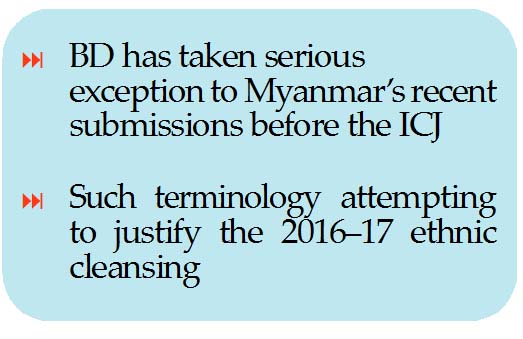
In a strong reaction issued by Foreign Ministry, Bangladesh has taken serious exception to recent submissions made by Myanmar before the International Court of Justice (ICJ), where the Rohingya were described as “Bengalis.”
Dhaka said such terminology is intended to construct a narrative of illegal migration and internal security threats, thereby attempting to justify the 2016-17 “clearance operations” as counter-terrorism measures while diverting attention from atrocity crimes committed against the Rohingya population.
Bangladesh reiterated that the Rohingyas are a distinct ethnic group that evolved over centuries in the Arakan region,
predating its incorporation into the Barman Kingdom in 1785.
Historical records indicate that the community lived in and around the former Arakan capital, variously known as Myo-Haung, Mro-Haung, or Rohaung, from which the term “Rohingya” is believed to have originated.
According to Foreign Ministry, the community adopted the name as a form of self-identification amid growing marginalization in Burma, and their deep historical, cultural, and social roots in present-day Rakhine are well documented in colonial records and independent scholarship.
The statement noted that attempts to portray the Rohingya as foreigners or recent migrants are inconsistent with historical facts.
The Rohingya were once an integral part of Myanmar’s political and social life, enjoying voting rights and participation in governance until the promulgation of the 1982 Citizenship Law, which excluded them from citizenship on ethno-religious grounds.
Despite sustained marginalisation, they retained voting rights until being fully disenfranchised ahead of the 2015 general elections. Their eventual expulsion from Rakhine, Dhaka said, rendered them stateless as part of a planned effort to destroy the community.
Bangladesh also rejected Myanmar’s continued use of the term “Bengali,” calling it a denial of the Rohingya’s inherent right to self-identify. While acknowledging linguistic similarities between the Rohingya language and the Chittagonian dialect of Bangla, Dhaka stressed that the Rohingya possess a distinct ethnic identity, culture, traditions, and language.
Labeling them as “Bengalis,” it said, has been central to a systematic campaign to deny them citizenship and fundamental human rights, despite their recognition as “lawful residents of Burma” under a bilateral repatriation agreement signed in 1978.
The government warned that such narratives undermine international efforts toward justice, accountability, and durable solutions to the Rohingya crisis.
It further accused Myanmar of persistently failing, for more than eight years, to fulfill its legal and bilateral obligations to create conditions conducive to the voluntary return of the Rohingya, in violation of agreements signed in 2017-18.
This continued inaction, Foreign Ministry said, could be interpreted as evidence of an intent to destroy the Rohingya community.
Additionally, Bangladesh recalled that on 18 July 2023 it formally protested Myanmar’s claim that “half a million Bangladeshi people” had taken refuge in Rakhine during Bangladesh’s 1971 Liberation War.
Dhaka noted that Myanmar failed to provide any documentary evidence to support the assertion.
The government of Bangladesh pointed out that Rakhine’s total population at the time was under 1.7 million, making the alleged presence of such a large refugee population implausible and unsupported by subsequent census data.
Reaffirming its position, Bangladesh urged Myanmar to abandon denial and delay, recognise the Rohingya’s rightful identity, and take concrete steps to ensure their safe, voluntary, and dignified return to Rakhine with full rights as equal members of society.