
July Memorial Museum to guide the nation: CA
Staff Reporter :
Chief Adviser Professor Muhammad Yunus on Tuesday said the July Uprising Memorial Museum would serve as a moral and historical compass for the nation, stressing that if Bangladesh ever becomes bewildered or loses its way, it will find its path within the museum.
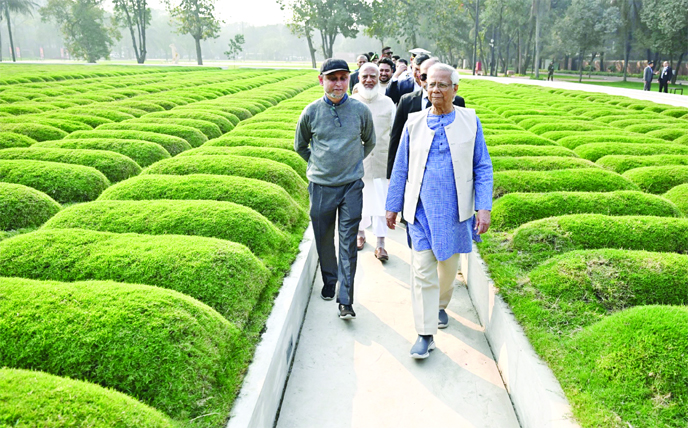
“It has been possible to build this museum while the blood of the July martyrs is still fresh. This is an unprecedented example for the entire world,” Prof Yunus said, adding, “We do not want there to be a need to build such a museum anywhere in the future. If our nation ever becomes perplexed for any reason, it will find its path in this museum.” He made the remarks in the afternoon after inspecting the final phase of construction of the July Uprising Memorial Museum at Gonobhaban, the former official residence of ousted prime minister Sheikh Hasina.
During his visit, Prof Yunus toured different sections of the museum, which document the background of the July mass uprising and portray what organisers describe as the history of the Awami League’s 16 years of misrule under the dictatorship of Sheikh Hasina.
Calling on citizens to engage deeply with the museum, the Chief Adviser said every Bangladeshi should visit the site and spend a full day there, and that students should be brought in groups. “Spending a day in this museum will help people understand what kind of brutality the nation had to go through,” he said.
Referring to the symbolic “Aynaghar” set up inside the museum, Prof Yunus said visitors should be allowed to sit inside the space for hours, or even an entire day, if they wish.
“By sitting inside the ‘Aynaghar’, visitors will be able to realise the level of brutality in which detainees were kept,” he said.
He stressed the need for national unity to ensure such events never recur.
“Everyone must internalise how we can remain united so that such brutal incidents never happen again,” he said. “On this one point, we will all remain united — that this nation will never return to such brutal days again.”
Recalling the July uprising, Prof Yunus said it was the youth and students who first stood up against brutality and resisted repression.
“They had no weapons and nothing at all. That ordinary people can stand up fearlessly and courageously in front of weapons — this is a lesson for all of us,” he said.
The Chief Adviser expressed gratitude to Cultural Affairs Adviser Mostofa Sarwar Farooki and all those involved in building the museum.
Speaking at the event, Farooki said it was a record that the project had reached its current stage within such a short period.
He credited the progress to the tireless efforts of many young people, noting that a large number worked at the site for eight months without any remuneration.
“Many of them worked here without pay. We are deeply grateful to them,” he said.
Farooki added that work on several additional sections would be completed in the coming days and that the museum would be opened to the public before the February 12 national election.
“The July Museum will stand as a bearer of history and will remain a source for Bangladesh’s past, present and future politics,” he said.
He also said the museum would play an important role in political discourse, education and research, as well as in cultural and literary practice.
BNP Standing Committee member Salahuddin Ahmed, Bangladesh Jamaat-e-Islami Ameer Dr Shafiqur Rahman, National Citizen Party Convener Nahid Islam, advisers of the interim government, and victims and family members of victims of enforced disappearance were present during the visit.
The July Uprising Memorial Museum has been set up at Gonobhaban, transforming the former seat of power into a site of remembrance, reflection and public education about the events that led to last year’s mass uprising.