
Govt to run ‘Yes’ campaign as CA for referendum
Staff Reporter :
As the country’s prepares for a nationwide referendum on institutional reforms scheduled for February 12, the interim government has decided to launch coordinated campaigns at universities, colleges, schools and madrashas across the country to encourage students to vote “Yes.”
The decision was taken at a meeting held on Sunday afternoon at the University Grants Commission office in Dhaka, involving officials from the Secondary and Higher Education Division, the Technical and Madrasah Education Division, the National University and the UGC, according to the Chief Adviser’s Press Wing.
Chief Adviser’s special assistants Professor Dr Ali Riaz and Monir Haidar attended the meeting alongside UGC Chairman Professor Dr SMA Faiz, Secondary and Higher Education Division Secretary Rehana Perven, Technical and Madrasah Education Division Secretary Muhammad Rafiqul, National University Vice-Chancellor Professor ASM Amanullah and UGC member Professor Mohammad Tanzimuddin Khan.
Under the plan, leaflets and booklets titled “Yes for Change” will be distributed among students.
Documentaries, video clips and campaign songs produced on the referendum will be circulated through mobile platforms and official social media pages of universities.
Banners, festoons and stickers will also be displayed across educational institutions.
Speaking at the meeting, Dr Ali Riaz said the referendum represented an opportunity to dismantle what he described as a “fascist state structure” and to build a humane and genuinely democratic system through state reforms.
“There is no alternative to a ‘Yes’ vote to establish a humane and democratic state,” he said.
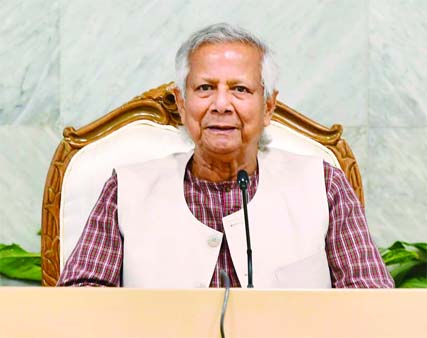
The decision comes amid growing public debate over whether the interim administration and Chief Adviser Professor Muhammad Yunus should openly campaign for a particular outcome.
In a separate statement issued Sunday afternoon, the Chief Adviser’s Press Wing defended Professor Yunus’s support for a “Yes” vote, arguing that such advocacy is consistent with democratic norms and the specific mandate of the interim government.
“Recent commentary has raised concerns that the Interim Government and the Chief Adviser’s open support for a ‘Yes’ vote may be inconsistent with the expectations of an interim administration,” the statement said.
“These concerns deserve respectful consideration. However, when assessed in light of Bangladesh’s political context, the mandate of the interim government, and comparative international practice, such criticism does not withstand close scrutiny.”
The statement said Bangladesh’s interim government was formed not to act as a passive caretaker, but to stabilise the state, restore democratic credibility and deliver a framework of reforms before returning power to an elected government.
It described the current reform package as the product of more than a year of consultations with political parties, civil society, professional groups and youth representatives.
“To suggest that the Chief Adviser should now refrain from advocating for these reforms is to misunderstand the very purpose of the interim arrangement,” it said, adding that leadership requires clarifying choices, not retreating into silence.
The government also argued that democratic practice worldwide allows, and often expects, heads of government to campaign publicly for referendums tied to major national changes, provided voters remain free to reject those positions and opposition voices can campaign openly.
Citing international precedents, the statement referred to referendums in the United Kingdom, Scotland, Turkey, Kyrgyzstan and France, where sitting leaders actively advocated for particular outcomes.
“What matters for democratic legitimacy is not whether leaders take a position, but whether voters are free to reject that position, the process is transparent and credible, and those conditions remain intact,” the statement said.
Addressing concerns over state-led outreach, the government said campaigns organised through educational institutions and district administrations were aimed at explaining the substance of the reforms and countering misinformation, not coercing voters.
“An interim government that declines to support the reforms it has championed would weaken public confidence and confuse voters,” the statement said, concluding that Professor Yunus’s advocacy reflects institutional responsibility, not partisan behaviour.
The referendum, the statement stressed, will ultimately be decided by the people. “Leadership does not negate that choice. It helps clarify it.”