News Analysis: BNP vs Jamaat Why Bangladesh’s Election Is Turning Into a “Neck-and-Neck” Race

Editorial Desk :
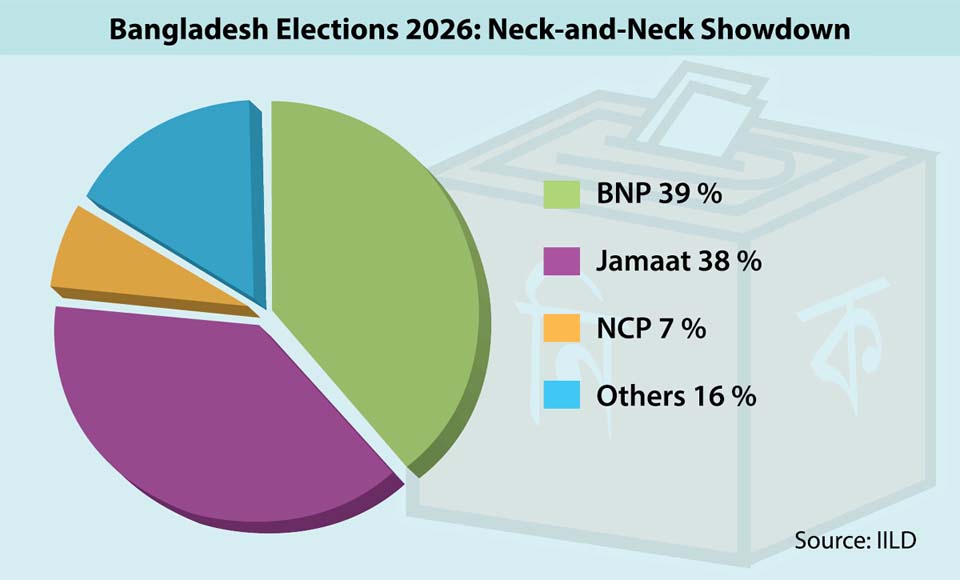
Bangladesh’s political conversation is increasingly shifting from “who will win?” to “how close will it be?” – as multiple survey reports and public mood indicators suggest that the next national election could become an unexpectedly competitive contest between Bangladesh Nationalist Party (BNP) and Jamaat-e-Islami.
While BNP still appears to hold the national lead in most polling narratives, the more striking development is the rapid narrowing of the gap, with some survey coverage describing the contest as “neck-and-neck.”
In an electoral system shaped by constituency-level wins rather than national vote share, that closeness could produce outcomes far more complicated than a simple BNP victory.
Why “Neck-and-Neck” Matters
The term “neck-and-neck” does not necessarily mean both parties have equal strength everywhere. It means:
BNP is still leading in national preference,but Jamaat has grown enough to become a direct challenger, not just a supporting force, and the margin is now small enough that seat outcomes could swing dramatically based on alliances, turnout, and local candidates.
In practical terms, even a 4-5 percentage point difference nationally is not safe under Bangladesh’s election rules.
BNP and Jamaat may look close in polls – but politically they represent different futures.
BNP offers:
# a familiar nationalist democratic framework
# continuity of mainstream electoral politics
# a return to the traditional two-party power structure
Jamaat offers:
# a disciplined reform narrative
# moral/anti-corruption appeal
# a vision where Islam plays a larger role in governance
BNP’s lead is thin – and morally fragile
BNP’s narrow edge in the polls reflects anger more than endorsement. For many voters, BNP is not a vision of the future; it is simply the most recognisable vehicle for protest.
BNP has yet to convincingly answer basic questions:
# What exactly will it do differently on the economy?
# How will it dismantle entrenched corruption networks it once tolerated?
# How will it govern without repeating the cycles of vendetta and instability that defined earlier eras?
A poll lead built on resentment can evaporate overnight. Unless BNP articulates a credible, reform-driven programme-and demonstrates discipline within its own ranks.
Being the “default opposition” is not the same as being a credible governing alternative.
Jamaat’s rise exposes a dangerous gap
Jamaat’s surge should alarm the political establishment-not because voters are becoming more religious, but because mainstream politics has failed to deliver clean governance.
Jamaat has successfully marketed itself as disciplined, incorruptible, and morally upright in a system widely perceived as rotten. That message resonates in an environment where accountability has collapsed.
But Jamaat’s ascent also raises unavoidable questions:
# Can it credibly guarantee pluralism in a diverse society?
# Can it protect minority rights without ambiguity?
# Can it separate religious values from coercive state power?
So far, Jamaat has benefited from not having to answer these questions in power. Polls reward clarity of message, not capacity to govern. Bangladesh cannot afford to confuse the two.
How NCP’s 7% Could Decide Bangladesh’s Next Election
In election politics, numbers can be deceptive. A party polling 7% nationally may sound minor compared to giants like BNP or Jamaat – but in Bangladesh’s electoral system, even a small share can become a game-changer.
The National Citizen Party (NCP), despite holding only single-digit support in several survey reports, could still shape the election result in three powerful ways: spoiler, seat-winner, or kingmaker.
In a political climate where many constituencies are expected to be closely contested, NCP’s 7% may not just “matter” – it may decide who governs Bangladesh.
If NCP’s support comes mostly from anti-BNP voters, Jamaat wins.
If it comes mostly from anti-Jamaat voters, BNP wins.
So NCP becomes the silent force that decides dozens of constituencies – without winning them.
In Bangladesh’s next election, the biggest story might not be whether BNP or Jamaat wins the most votes.
It might be how smaller forces – especially a 7% party – reshape the winner’s path to power.
The polls are a mirror, not a verdict
The BNP-Jamaat polling contest is not a celebration of choice. It is a mirror reflecting public frustration, institutional decay, and a dangerous narrowing of political imagination.