
What survey shows on 2026 election?: BNP-Jamaat’s two-front battle
Staff Reporter :
With less than one month left of the 13th National Parliamentary Election, political parties are busy with last-minute preparations. At this crucial moment, a private nationwide survey has revealed a new reality of electoral politics.
Breaking away from the long-standing BNP-Awami League two-party rivalry, this time the battle for power is shaping up between long-time political allies-BNP and Jamaat-e-Islami.
The survey shows that the gap in support between the two parties is extremely narrow. As a result, the final outcome of the election largely depends on the 17 percent undecided voters-who may ultimately emerge as the real “kingmakers.”
The survey was conducted from November 21 to December 20 across 295 parliamentary constituencies in all 64 districts of the country.
The survey was jointly carried out by Projection BD, the International Institute of Law and Diplomacy (IILD), Jagaran Foundation, and Narrative. The study titled “Pre-Election Pulse: An In-Depth Analysis of the Bangladeshi Electorate.”
The findings show that relatively highly educated voters are more inclined toward Jamaat, while less-educated voters tend to support BNP.
Experts said they institutions conduct surveys have to use right methodology to reflect the real scenario of voters choice.
When contacted, eminent political analyst, Professor SM Ali Reza of Dhaka University told The New Nation on Tuesday, “Institutions which conduct surveys have to use right methodology to bring out the real picture of the voters preferences.”
He said the media have a great role to assist voters to bring back electoral culture.
The professor said, surveys usually create healthy competition.
High Voter Turnout, Deep Crisis of Trust
According to the survey, 86.3 percent of voters are interested in voting in the upcoming election. Only 2.3 percent said they would not vote, while 11.4 percent remain undecided. This suggests that, if a participatory election is held, voter turnout is likely to be relatively high.
However, hesitation and a crisis of trust are clearly visible among young, urban, and educated voters.
On one hand, BNP is gaining support due to expectations of governance experience and stability; on the other, Jamaat is ahead in terms of perceived honesty, an anti-corruption image, and a message of political change.
In this context, the upcoming election is not merely about a transfer of power, but rather a deep political contest between change and stability.
Methodological Strength of the Survey
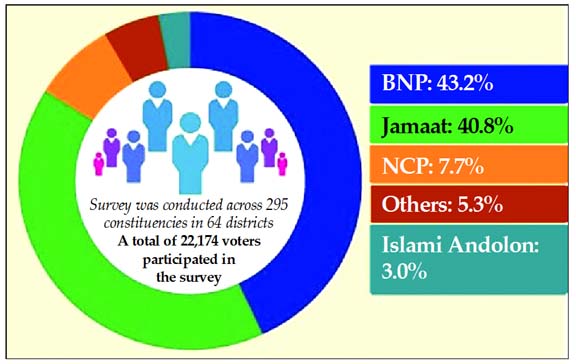
A total of 22,174 voters participated in the survey. The sample was selected in line with the actual urban-rural population ratio based on the 2022 census. Post-stratification weighting by district and type of residence helped balance the influence of over-sampled districts (such as Dhaka) and under-sampled districts (such as Bandarban). The average interview duration was 11 minutes.
The survey findings were presented by IILD Executive Director Shafiul Alam Shaheen. Discussants included political analyst and SOAS University of London professor Dr. Mushtaq Hossain Khan; Dean of the School of Business at North South University, Dr. AKM Waresul Karim; Chairman of the Center for Security and Development Studies, Major General (Retd.) Amsa Amin; BDJobs CEO AKM Fahim Mashroor; and several other researchers and analysts.
Current Party Support Landscape
Current support levels:
BNP: 34.7%
Jamaat-e-Islami: 33.6%
Undecided: 17.0%
NCP: 7.1%
Islami Andolon: 3.1%
Others: 4.5%
In other words, BNP and Jamaat are virtually neck and neck.
Machine Learning Forecast: A Cliff-Hanger Contest
When machine learning models are applied to analyze the behavior of undecided voters, the projected scenario becomes:
BNP: 43.2%
Jamaat: 40.8%
NCP: 7.7%
Others: 5.3%
Islami Andolon: 3.0%
According to this projection, BNP is slightly ahead, but the margin is extremely narrow. Coalition strategy, candidate selection, and grassroots organization will play decisive roles in determining the final outcome.
Young Voters: The Most Uncertain Force
Among voters aged 18-29, BNP’s support is comparatively lower (around 28-30 percent), while the proportion of undecided voters is higher. Young voters are particularly sensitive to issues of change, corruption-free politics, and employment.
Urban-Rural Divide
In rural areas, BNP’s support stands at 35.9 percent, compared to 31.9 percent in urban areas. In cities, the undecided voter share is 21.5 percent-indicating political uncertainty among the urban middle class and young voters.
Regional Power Map
Mymensingh and Barishal: BNP strong (42-47%)
Rajshahi and Khulna: BNP and Jamaat almost equal
Dhaka and Sylhet: High proportion of undecided voters
Chattogram: Multi-cornered competition
Trends by Education and Profession
Support for BNP is higher among less-educated voters (39-40%). Among highly educated voters, uncertainty and a tilt toward alternative political forces are evident. BNP’s support is lowest among students and unemployed youth.
Why Parties Are Gaining Support
BNP: Past governance experience (72%); perceived ability to run the state; expectations of stability
Jamaat: Image of being corruption-free; honesty and organizational discipline; politics of change
NCP: Role in the July movement; reform agenda and new political narrative
Reasons for undecided voters’ hesitation:
Lack of trust in any party – 38.6%
Low interest in politics – 30.1%
Political uncertainty – 18.1%
Waiting to see election manifestos – 10.2%
Concerns over uncertainty of participation
If any major party boycotts the election, a large portion of its supporters may abstain from voting. This could intensify political debate over the legitimacy and inclusiveness of the election.
The survey shows that 58.6 percent of Awami League supporters said they would not vote if their party does not contest the election.
Change vs. Stability: The Core Conflict Dr. Mushtaq Hossain Khan noted that in earlier surveys BNP was ahead of Jamaat, but in the current survey the combined strength of Jamaat, NCP, and Islami Andolon surpasses BNP.
Young, educated, and urban voters are leaning toward politics of change, while businesspeople, workers, and farmers are inclined toward BNP in search of stability.
According to him, the July mass uprising created a revolutionary turning point. One segment of society wants fundamental change, while another seeks rapid stability. This tension is the main driving force of the upcoming election.
Major General (Retd.) Amsa Amin believes that parties taking an uncompromising stance against India’s hegemonic influence will gain an advantage at the polls.
Dr. Waresul Karim pointed out that this is the first time since 1996 that BNP and Jamaat are contesting elections separately, and for the first time the Awami League is absent from the electoral field. The rise of NCP as a new force is also reshaping the political equation.
Political Implications: Which Way Is Bangladesh Heading?
The survey highlights three major signals:
Two-party politics has broken down, giving rise to a dual-force competition.
Ethics and anti-corruption politics are becoming the primary expectations of voters.
The crisis of trust among young and urban voters signals potential future political instability.
If these trends continue, the 2026 election may not merely be a struggle for power, but a crucial turning point in redefining Bangladesh’s political ideology and state vision.