Joypurhat to produce 200 tons of jaggery
Joypurhat Correspondent :
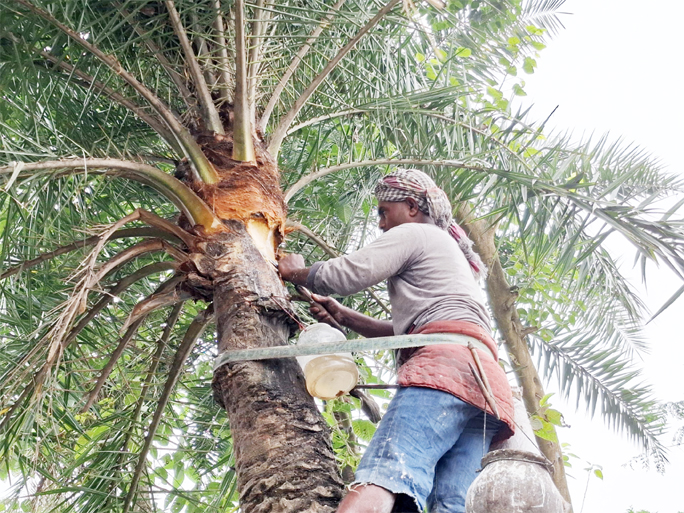
The biting cold has settled over the northern region, and in the border district of Joypurhat, date tree tappers are collecting sap from the trees.
The sap is being processed into delicious and appetising jaggery. Before the cold, foggy mornings, the sap-filled clay pots are carefully collected from the trees and boiled on large tin pans to produce Patali and Lali jaggery. In villages such as Kutibari, Challi Pirer Dargah, Hanail, Bondhu Akkelpur, and Pachbibi, the tappers rent date trees to collect sap and prepare pure jaggery using nets.
The demand for this jaggery is high, as locals enjoy it with various traditional sweets like pitha and sandesh. Due to its high quality, buyers and traders come from distant areas to purchase the jaggery. Many also come to taste the fresh date sap. However, the district civil surgeon has advised not to consume raw sap due to the risk of Nipah virus, recommending that it be boiled or processed into jaggery first.
Joypurhat, a small border district in the north, has experienced severe cold for nearly a week. Dense fog and light chilly winds have intensified the winter’s grip. Amid this cold, nearly 500 tappers have arrived from across the country to collect date sap.
They are harvesting sap from approximately 15,000 date trees in the district. From midnight to daytime, the work continues relentlessly. The collected sap is boiled to produce delicious Patali and Lali jaggery. Despite the freezing cold, tappers climb the trees at dawn to collect sap, which is then boiled on large pans for three to four hours. After several further steps, the final jaggery is ready.
The production season is expected to continue for around four months, and the Agriculture Department anticipates producing approximately 200 metric tons of jaggery in the district this season.
Ansar Ali, a tapper from Rajshahi currently working in Kutibari Bridge area of Joypurhat Sadar, said: “In Kartik month, we come to Joypurhat and hang pots on the date trees in various areas. Six of us collect sap from around 350 trees daily, yielding 30 to 35 mon of sap.
This produces 2 to 3 mon of jaggery each day, totaling 120-125 mon a month, and around 500 mon for the whole season.” Another tapper, Abdul Alim, added: “Tappers come from different districts and set up temporary shelters to prepare jaggery in various areas of Joypurhat. We leave at 3 a.m. to collect sap from the trees, then boil it on pans early in the morning. After 3-4 hours, jaggery is ready. The best quality sells at 400 Taka per kg, while normal quality is 200 Taka per kg. Date sap itself is sold at 60 Taka per kg.”
Majedul, another tapper, said: “Seven of us collect sap from various areas, then boil it for 3-4 hours to make jaggery. Traders and customers come to buy the jaggery, and some come just to taste the fresh sap. We produce pure, adulteration-free jaggery and sap here. If the government could provide training and other support, we could produce and market jaggery even more efficiently.”