Both BNP, Jamaat confident of winning

Rajshahi Correspondent :
Since the announcement of the schedule for the national parliament elections, the election heat has been increasing in Rajshahi-5 (Puthia-Durgapur) constituency. Candidates are active in the field day and night to reach out to voters.
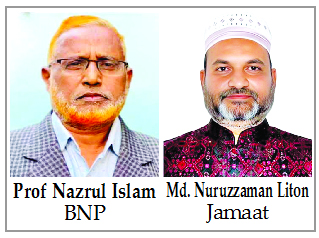
BNP’s senior leader Professor Nazrul Islam Mondal has received the nomination here. After the nomination was announced, most of the party’s leaders and workers protested on the streets, calling it ‘isolated’ from the people.
As a result, BNP’s politics in the constituency is facing extreme uncertainty. On the other hand, Jamaat-e-Islami is trying to use this situation in its favor through party unity and organized programs. Political analysis shows that BNP’s once strong base is breaking due to disunity. And public support for Ekatta Jamaat is increasing.
Rajshahi-5, which consists of Puthia and Durgapur upazilas. The total number of voters is 3 lakh 53 thousand 173. In the past, this constituency was known as a stronghold of BNP. In the 1996 and 2001 national elections, BNP’s late leader Advocate Nadim Mustafa was elected as a member of parliament for two consecutive terms. Later, in the 2008 and 2018 elections, former chairman of Puthia Upazila Parishad, Professor Nazrul Islam Mondal, received BNP’s nomination. He is BNP’s party candidate again this time.
Jamaat-e-Islami has been active in the field to take advantage of the turbulent situation of BNP. As the party’s sole candidate, Rajshahi East District Jamaat Assistant Secretary Md. Nuruzzaman Liton is regularly conducting mass communication and organizational programs.
Political observers are of the opinion that the party’s public support is increasing as Jamaat leaders and workers are campaigning unitedly at the local level. In addition, Ruhul Amin of the Islamic Movement, Mufti Abdul Hamid of the Khilafat Majlis, Zahura Sharmin of the LDP and Abir Chowdhury, a member of the district NCP, are campaigning from their respective positions.
Voters of Rajshahi-5 constituency are going to get the opportunity of a competitive election after a long 17 years. Young voters in particular have expectations of re-establishing democracy and building a fascism-free state. They do not want the politics of party conflict, but rather a candidate who, if elected, will work as a representative of the common people, not of a party or group. According to political analysts, the results of the Rajshahi-5 constituency will largely depend on how quickly BNP can handle its internal conflicts and how much Jamaat is able to transform its organized power into votes.