
National election, referendum on Feb 12
Staff Reporter :
The Election Commission on Thursday announced that its long-delayed national election will be held on February 12, a date that now stands as a defining moment in the country’s attempt to restore democratic order after the mass uprising of 2024 dismantled the entrenched political establishment.
The announcement, delivered in a televised address by Chief Election Commissioner A.M.M. Nasir Uddin, also confirmed that a nationwide referendum on implementing the July National Charter will take place the same day — a dual exercise unprecedented in scale and political significance.
The schedule places the interim government, led by Nobel laureate Muhammad Yunus, under mounting pressure to steer the country toward a credible vote, 16 months after it assumed office in the wake of the ousted Awami League administration.
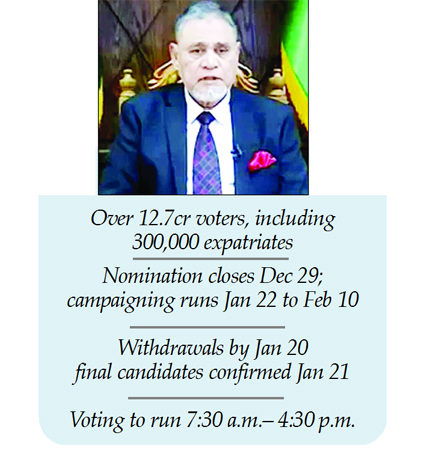
The commission’s timetable sets December 29 as the deadline for filing nominations, with scrutiny to begin a day later and continue into early January.
Candidates will have until January 20 to withdraw; official symbols and a final list will be issued on January 21. Campaigning is to run from January 22 until the morning of February 10.
With more than 127.6 million eligible voters — including, for the first time, over 300,000 expatriates who have registered for postal ballots — the election is set to be one of the largest democratic exercises in the country’s history.
Yet it unfolds under the shadow of an uprising that shattered long-standing political structures and forced the resignation of the Awami League government on August 5 last year.
The party’s registration remains suspended, barring it from contesting under its traditional symbol, a stark reminder of the political rupture that followed the revolt.
The Election Commission acknowledged that administering a parliamentary election alongside a referendum will strain the country’s logistical capacity.
Polling hours have been extended by an hour, from 7:30 a.m. to 4:30 p.m., and additional secret voting booths will be installed across thousands of stations.
Security has also become a central concern, with the government preparing to deploy nearly 900,000 personnel from the armed forces, police and auxiliary units — the largest mobilization for any election in Bangladesh’s history.
More than 150,000 police officers have already undergone specialized training.
The road to February has been shaped by months of negotiation, shifting expectations and recalibrated political realities.
Early last year, when the interim authority took charge, several parties — including the BNP — pressed for elections by December.
But by June, the timeline appeared to drift after the chief adviser indicated that polls might wait until April 2026.
Days later, BNP’s acting chairman Tarique Rahman met Yunus in London, where the two agreed that the vote should be held in early February 2026 — a date the government later accelerated, bringing it forward to February 2025 and pairing it with the referendum.
Now, with the schedule announced, Bangladesh enters a consequential stretch in which the credibility of its democratic resurgence will be tested not only at the ballot box but in the institutions responsible for conducting the vote.
For the interim government, the February election represents both a promise and a deadline — the moment when the country must begin its transition from the turbulence of the uprising toward a restored, and perhaps reimagined, democratic order.