
PRI hosts roundtable on financial sector risks and reforms

Business Report :
Bangladesh’s proposed Banking Resolution Ordinance will remain ineffective unless the country urgently builds the capacity to manage failing banks, protect depositors and prevent systemic risks, speakers at a high-level roundtable cautioned yesterday.
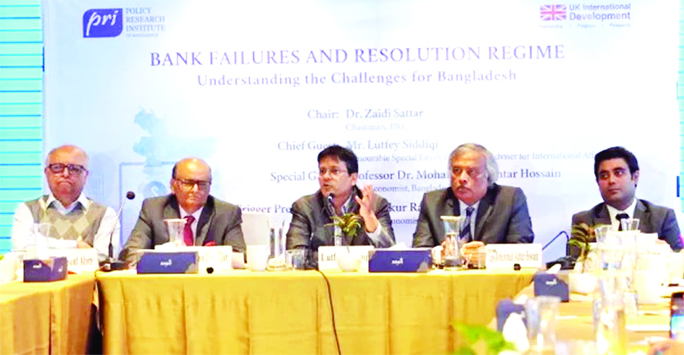
The Policy Research Institute of Bangladesh (PRI), with support from the Foreign, Commonwealth & Development Office (FCDO), organised the discussion titled “Bank Failures and Resolution Regime: Understanding the Challenges for Bangladesh” at Hotel Amari, Dhaka. The event brought together senior policymakers, economists, and central bank officials at a time when the banking sector is facing deep stress and record non-performing loans (NPLs).
Lutfey Siddiqi, special envoy to the chief adviser for international affairs, attended the event as chief guest and delivered a stark message.
“If the banking sector continues with business as usual, nothing will change. Ensuring good governance-regardless of which political party forms the government-is essential,” he said, stressing that the Ordinance alone cannot solve the structural weaknesses eroding the stability of the sector.
A keynote presentation was delivered by Ashikur Rahman, principal economist at PRI, who warned that the hardest part of reform is yet to begin.
“Passing the Banking Resolution Ordinance is only half the job,” he noted. “What must follow now is a serious investment in processes, systems, and institutional capacities that will allow Bangladesh Bank and the financial sector to actually implement the resolution regime.” Rahman highlighted the need for operational strength from supervisory tools and valuation expertise to recovery mechanisms and clear decision protocols, arguing that these elements are essential for restoring confidence and rebuilding resilience in the financial system.
PRI Chairman Zaidi Sattar painted a troubling picture of the current scenario, pointing out that non-performing loans have soared to nearly 35 percent, a level he described as “unprecedented.”
“This is something we did not see even in countries struck by the global financial crisis,” Sattar said. “In advanced economies, we spoke of institutions being ‘too big to fail’; in Bangladesh, many distressed banks are instead ‘too toxic to fail,’ as allowing them to collapse would transmit severe contagion across the economy.”
Despite the severity of the challenges, Sattar said there are early signs of recovery: “The encouraging sign is that the hemorrhage within the sector has stopped, and the banking sector is seeing some light again.”
Senior officials from Bangladesh Bank Mohammad Zahir Hussain, executive director of the Bank Resolution Department, and Professor Mohammad Akhtar Hossain, chief economist attended as special guests. Prof Akhtar underscored the broader economic implications of the banking crisis, especially its impact on foreign investment.
“Our FDI-to-GDP ratio is already very low, and the combination of high NPLs and ongoing political uncertainty is making it extremely difficult to attract foreign direct investment,” he said.
As the government prepares to move forward with the Banking Resolution Ordinance, experts at the event stressed that only a robust, well-resourced implementation framework can prevent future bank failures and restore long-term stability in Bangladesh’s financial sector.