
BD sets own policy, not IMF, WB’s: BB Governor: National economy turns around : Experts
Reza Mahmud :
Bangladesh’s national economy is turning around overcoming the last 17 years destructions created by fascist and plunderer Hasina government, economists said.
They said, the economy is turning towards development on the base of stable banking sector, strong growth of remittance, stable dollar market and potentials of foreign direct investment (FDI) and local ventures.
They said after the February national polls huge local and foreign investment will be found in several sector which will bring the economy in a remarkable stage.
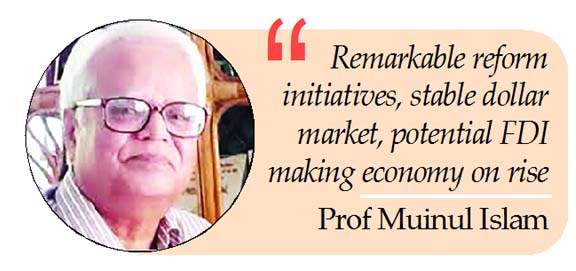
When contacted, eminent economist Professor Muinul Islam on Thursday told The New Nation, “On the base of the interim government’s remarkable reform initiatives in economic sectors and stable current dollar market, the country’s economy is turning around overcoming the past destructions.”
The Professor said, there are potentials of getting enormous FDI and local investment in the country.
He, however said, the interim government have failed to curb corruption, if the next elected government become success to reduce corruption the economic growth will be more faster.
Meanwhile, Bangladesh Bank Governor Dr Ahsan H Mansur on Thursday asserted that the country independently formulates its economic policies and is not driven by prescriptions of the International Monetary Fund (IMF) or the World Bank.
“If we had blindly followed their recommendations, the exchange rate would have jumped to Tk 170-180 per US dollar-similar to what happened in Pakistan and Sri Lanka,” he said.
The governor made the comments while speaking as the special guest at the Investment Dialogue with Local Partners, held at the multipurpose hall of the Bangladesh Investment Development Authority (BIDA). Energy Adviser Muhammad Fouzul Kabir Khan attended the event as chief guest.
Dr Mansur said inflation is likely to ease to 5 percent by the end of FY2025-26. As a result, the policy rate could come down to 8-9 percent, with lending rates stabilising between 10 and 11 percent.
He cautioned, however, that lowering interest rates without first taming inflation could destabilise both the exchange rate and the broader money market, noting that businesses’ calls for cheaper loans must be balanced with macroeconomic realities.
Citing India and China as examples, he pointed out that their low interest rates-3 percent and zero percent, respectively-reflect economic circumstances that are different from Bangladesh’s.
“We are not currently taking IMF loan installments because some of their conditions cannot be implemented at this moment without harming our economy. When the time is right, and once we fully meet their requirements, we will take the next tranche,” he said.
Regarding the financial sector, Dr Mansur said the banking system has now moved away from the data manipulation practices that had previously posed serious risks.
Under the earlier administration, official inflation was projected as single-digit while the real figure hovered around 12-13 percent. Lending rates were kept artificially low, leaving depositors with negative returns.
Similarly, defaulted loans were reported as below 10 percent when, in reality, they stood at nearly 35 percent as of September 2025. “These discrepancies have now been corrected,” he noted.
Addressing concerns over recovering bad loans through asset sales, the governor stressed that industries should not suffer because of mismanagement by individuals.
He cited the SS Power Plant of S. Alam Group, which continues operations with Bangladesh Bank’s support for opening LCs. The project, involving around US $2.5 billion-80 percent of which is foreign-owned-will continue running, but the company will not retain profits as all funds will go toward debt repayment, he said.
Dr Mansur added that Bangladesh Bank has received around 1,300 applications for loan restructuring, of which 250 have been approved. The remaining applications have been forwarded to the relevant banks for case-by-case evaluation.
He projected that defaulted loans could decline by 5 percent by March of FY2025-26, though achieving a sustainable level of non-performing loans may require 8-10 years.
The discussion also featured Lutfey Siddiqi, Special Envoy of the Chief Adviser for International Affairs, and NBR Chairman Mohammad Abdur Rahman Khan, FCMA. The dialogue was chaired by Chowdhury Ashik Mahmud Bin Harun, Executive Chairman of BEZA and BIDA.