
Dhaka has one tree per 28 residents, 3 trees needed for each
Staff Reporter:
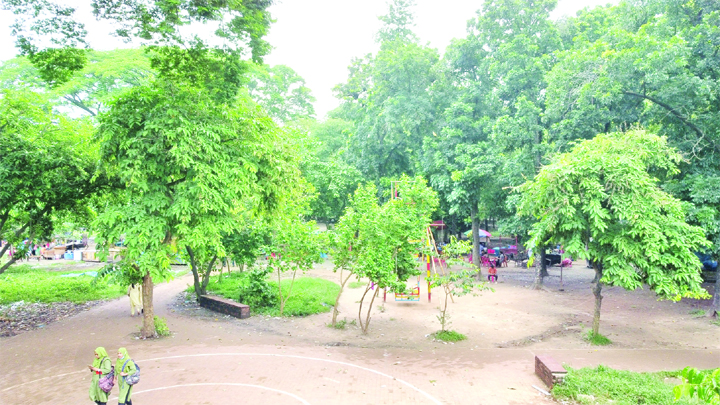
Environmental experts have warned that Dhaka now has just one tree for every 28 people, even though three fully grown trees are required to meet the daily oxygen needs of a single person.
They shared the alarming statistics at a discussion where it was also revealed that Bangladesh has lost nearly 100,000 acres of forest over the past decade.
These concerns were highlighted on Sunday during the concluding session of the four-day international conference titled “Political Commitment to Agriculture and Food,” organised by the Bangladesh Agricultural Journalists’ Forum (BJAFA).
Md Jahidul Kabir, additional chief conservator of forests, explained that while a person needs at least 550 litres of oxygen every day, Dhaka’s current tree-to-population ratio is dangerously inadequate. He said that three mature trees are required to produce that amount of oxygen, yet the capital has just one tree for 28 people.
Kabir added that around 250,000 acres of forestland across the country have been illegally occupied, accelerating deforestation. Illegal wildlife hunting, encroachment, forest fires, unauthorised construction, degradation of mangrove forests, unregulated river traffic and the mounting impacts of climate change are severely damaging ecosystems and biodiversity, he warned.
Citing official figures, he noted that Bangladesh’s forests currently hold about 394 million cubic feet of timber.
When trees outside forest areas are included, the country’s total biomass stores an estimated 973 million tonnes of carbon – with 251 million tonnes contained in natural forest cover.
As part of its reforestation programme, the Forest Department has distributed around 419,000 saplings free of charge. Once they grow, these trees are expected to enhance carbon absorption and help restore lost greenery.
Delivering the keynote speech, Md Amir Hossain Chowdhury, chief conservator of forests, reiterated that afforestation remains the most cost-effective and nature-based strategy to combat climate change. He cautioned that if Bangladesh’s economic development leads to an expansion of carbon-emitting industries, maintaining adequate forest cover will become even more critical.
Pointing to population density, he said that cities like Dhaka ideally need at least 20 percent green space, but current estimates suggest the city has little more than 10 percent green coverage.
In a special address, Abul Kalam Azad, CEO of Dhaka University’s Planter Skill Development unit, said that despite Bangladesh’s agricultural richness, progress in agriculture, reforestation and environmental conservation is being held back by political apathy, erosion of values, inequitable resource distribution and weak leadership. He argued that syndicates, political rivalries, extortion and poor enforcement of laws remain major barriers. Sustainable improvements in food security and environmental protection, he said, will require ethical leadership and strong governance.
The conference was chaired by BJAFA chairman Sahanowar Sayed Shaheen and moderated by its general secretary Abu Khalid.
The four-day event was co-sponsored by Asha Feed Industries Limited, with RFL Group, Lal Teer Seeds Limited, the World Poultry Science Association (Bangladesh chapter), Bangladesh Rice Research Institute, the Forest Department, Department of Agricultural Extension, Department of Fisheries and the Livestock Department serving as associate sponsors.