Ziaul kidnapped, killed hundreds before dumping bodies

Staff Reporter :
International Crimes Tribunal (ICT) Chief Prosecutor Tajul Islam has alleged that Major General (retd) Ziaul Ahsan, former director-general of the National Telecommunications Monitoring Centre (NTMC) was involved in the abduction, enforced disappearance, and killing of hundreds of people during the previous Awami League government.
He claimed that victims’ bodies were later dumped in rivers, canals, and wetlands after being mutilated.
According to Tajul, the tribunal’s investigation agency has gathered “exceptionally strong evidence” linking Ziaul to a series of grave offences. “The investigation agency has obtained extensive proof.
He abducted and killed hundreds of people and disposed of their bodies in waterways after cutting open their stomachs.
An accused of this scale must be investigated thoroughly for every allegation,” he said.
The chief prosecutor made the remarks yesterday at a press briefing held on the tribunal premises in Dhaka.
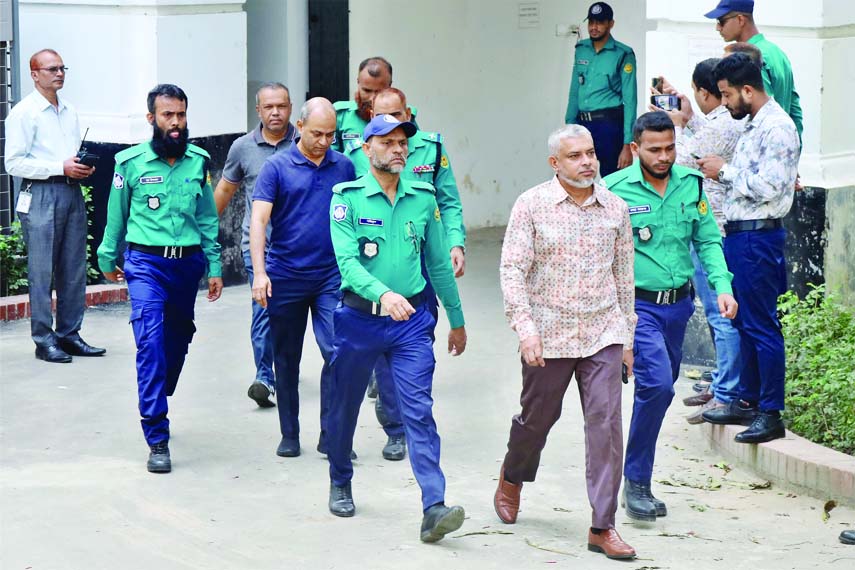
During Ziaul’s interrogation, his sister Naznin Nahar submitted an application seeking permission for her and his lawyer to remain beside him. The request led to a brief exchange between her and the prosecution during the hearing.
The crimes against humanity investigation is still underway. Of the 11 accused, the tribunal has publicly confirmed four names so far: ousted prime minister Sheikh Hasina, former defence and security adviser Major General (retd) Tarique Ahmed Siddique, former inspector general of police Benazir Ahmed, and Ziaul Ahsan.
The remaining seven accused have not been named. The tribunal has fixed 11 December for submission of the investigation report.
Tajul criticised the petition filed on behalf of Ziaul, saying it lacked specific legal grounds. “He even asked for access to his phone’s call records and messages, which have no relevance to this case.
No charge sheet has been submitted yet. If he wants those materials, he must approach the appropriate forum, not this tribunal,” he said.
He also clarified that under the International Crimes (Tribunals) Act, defence lawyers cannot sit in front of investigators during interrogation.
Since 2010, lawyers may stay in an adjacent room for transparency and meet the accused if necessary, with medical supervision also provided.
“These provisions are not in the law but are allowed in the interest of justice. Insisting on sitting beside the accused is unrealistic,” he said.
Tajul added that Naznin Nahar’s presence could obstruct questioning, given her dual role as both lawyer and sister. He said repeated “unnecessary applications” were delaying the investigation.
The prosecution has asked the court to ensure that interrogation proceeds carefully and strictly in line with legal procedure, noting that Ziaul is allegedly linked to the highest number of crimes uncovered so far.