Powerful 5.7 quake jolts country

Staff Reporter :
A powerful earthquake in recent memory rattled the entire country on Friday as a 5.7-magnitude quake shook Dhaka and several districts, killing at least ten people, including a newborn, and injuring hundreds.
The jolt struck at 10:38am, sending residents running into the streets as buildings swayed, cracked, or in some cases tilted.
The Bangladesh Meteorological Department said the epicentre was in Madhabdi, Narsingdi, about 24 kilometres east of Dhaka’s Agargaon seismic station, while the US Geological Survey put the magnitude slightly lower at 5.5 and located the epicentre 14 kilometres west-southwest of Narsingdi, with experts noting that the quake likely originated at a shallow depth of 10 to 12 kilometres, which explains why the shaking felt so intense.
Across Narsingdi, Khulna, Bogura, Magura, Rajshahi, Netrokona and Noakhali, reports poured in of homes rattling, shelves toppling, and people scrambling out in panic.
Chief Adviser Professor Muhammad Yunus on Friday said the government is keeping a vigilant eye on the situation following the earthquake and has directed all relevant agencies to immediately move to the field to evaluate any potential damage.
“The government is fully aware of the public concern and anxiety caused by the tremors felt across various parts of the country.
The situation is under close observation, and all concerned offices have been instructed to take prompt field-level action to assess possible impacts,” he said in a message issued by his press wing.
In Dhaka, the shaking lasted nearly 20 seconds, long enough to trigger alarm and structural damage in buildings old and new.
Prof Humayun Akhter, a leading seismic expert and former geology professor at Dhaka University, said, “In my experience, this was the strongest shaking Bangladesh has felt in decades. Buildings were trembling like trees.”
He noted that the region sits on the Indo-Burma tectonic plate, which has a long history of generating major earthquakes.
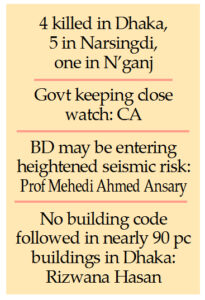
His concern was echoed by BUET earthquake specialist Prof Mehedi Ahmed Ansary, who warned that Bangladesh may be entering a period of heightened seismic risk.
“Historically, a magnitude-7 quake hits this region every 100 to 125 years, and an 8-magnitude every 250 to 300 years. Since 1930, we have not had a major one. The pressure is building,” he said.
He added that Dhaka’s vulnerability is extreme: “The city has around 21 lakh buildings. If a magnitude-7 quake hits within 100 kilometres of Dhaka, one to three lakh people could be killed or injured, and about 35 percent of buildings might collapse.”
“If any big scale earthquake takes place in Bangladesh, it would be devastating. It would be difficult to tackle the disasters after post earthquake. We don’t have enough open space.”
Dr Subrota Kumar Saha, Professor and Chairman of Department of Geology, Dhaka University told the New Nation.
“Our utility services including gas pipelines are haphazard. Buildings are being constructed on flood plains where the earth is soft,” he said.
“We also do not have extensive study on the earthquakes. Energy is being stored and is being released sometimes. But still we don’t know about the possibility of big earthquake.
The devastating Bengal earthquake took place more than 100 years ago,” Dr Md Bodruddoza Mia, Professor of Department of Geology, Dhaka University said.
On the other hand, Adviser Rezwana Hasan raised similar alarms earlier in the day, pointing out that nearly 90 percent of old buildings in Dhaka and Old Dhaka were built without following the code.
“This city is at extreme risk during any serious earthquake,” she told the media.
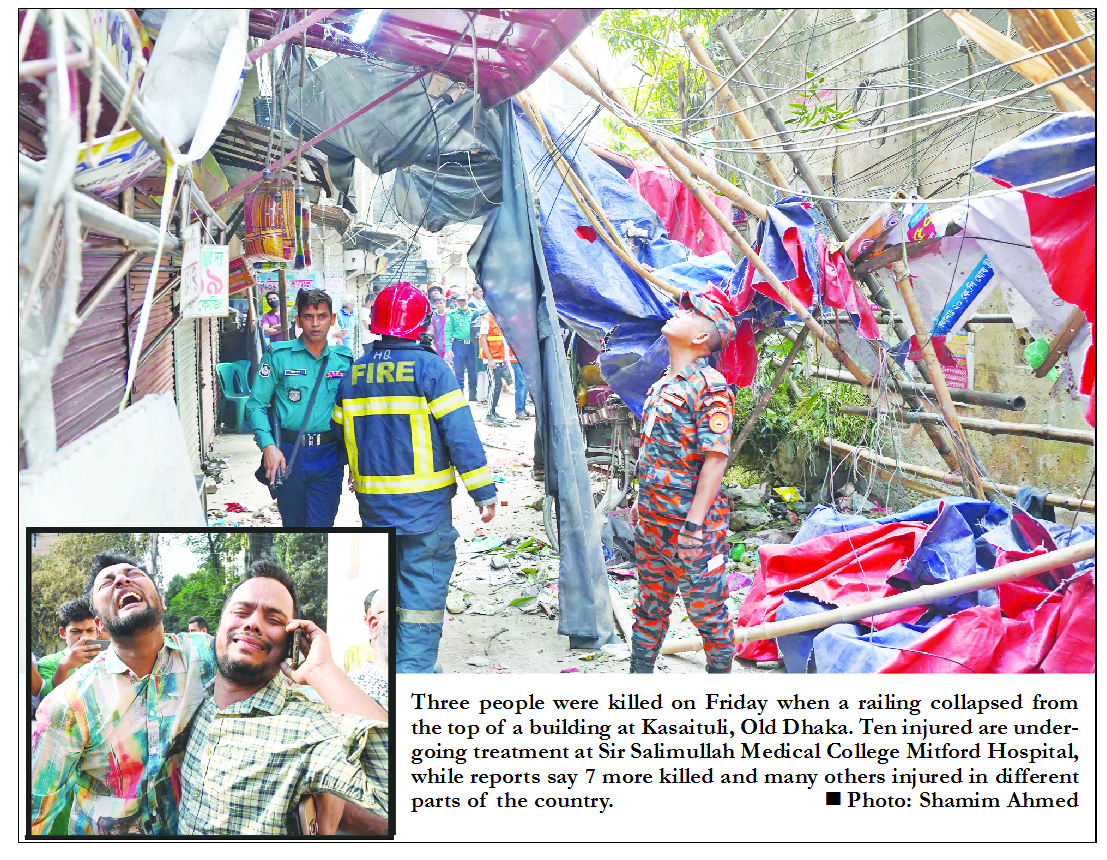
Meanwhile, fatalities were reported in Dhaka, Narayanganj and Narsingdi. In Old Dhaka’s Armanitola area, a railing collapse from a building killed three people on the street: Rafiqul Islam (20), Abdur Rahim (48), and his 12-year-old son, Mehrab while Maksud, (50) was killed in Mugda.
In Narayanganj’s Rupganj, a 10-month-old child named Fatema died when part of a structure gave way. According to office of Deputy Commissioner in Narsingdi, four people were killed and several hundred people were injured.
The deceased were Hafez Omar (08) in Sadar Upazila, Delwar Hossain Uzzal (42) father of Omar, Kazem Ali Bhuiyan (75) in Char Sindur Union and Nasiruddin (60) in Danga Union of Palash Upazila, and Forkan (40) in Joynagar of Shibpur Upazila.
Hospitals across Dhaka, Narsingdi and Gazipur reported treating more than 200 injured people, many hurt during stampedes as they tried to exit buildings.
Ghorashal fertilizer production was suspended temporarily due to the earthquake while several hundred buildings including Deputy Commissioner and Circuit House were cracked.
Gazipur alone admitted 252 people by late afternoon, most of them garment workers who were trampled or hurt while racing down staircases in tightly packed factories.
In Tongi’s Pinaki Garments and Fashion Plus Garments, panic triggered a crush at the gates as thousands attempted to flee at once. Similar scenes unfolded in Shreepur, where more than 150 workers were injured while rushing down from multi-storey buildings.
Fire Service and Civil Defence units responded to dozens of calls across Dhaka, Munshiganj, Rajshahi and Chattogram, ranging from building tilts to fires.
In Dhaka’s Kalabagan, residents thought an apartment block had tilted, prompting a call to the fire service. Officials later said the structure was stable. In Badda Link Road, one building leaned visibly.
A fire erupted in a Baridhara residence soon after the quake. While its cause remains unclear, two fire service units doused the blaze quickly. Another fire was reported in Munshiganj’s Gazaria upazila.
The quake also caused a section of Rajshahi University’s Sher-e-Bangla Hall to tilt. “We found numerous cracks. Students are not safe here. We will relocate them after Juma prayers,” Hall Provost Prof Md Shariful Islam said.
In Chattogram’s Mansurabad area, the top three floors of an aging six-storey building leaned onto another structure.
“It was already slightly tilted, but today’s quake made it much worse,” said Abdullah Ashraf, owner of the neighbouring building. Ten to twelve families live in the affected block.
The earthquake disrupted the national grid as six power plants tripped offline simultaneously, removing more than 1,100 megawatts from supply. Engineers were working to restore stability by noon.
Rubaiyat Kabir, head of the BMD’s Earthquake Observation and Research Centre, said Bangladesh sits at the intersection of the Indian and Eurasian plates and is crisscrossed with active faults, including the Assam, Dauki and Myanmar’s Sagaing faults.
“Since 2007, this is the strongest earthquake detected around Dhaka by our digital monitoring system,” he said. While no aftershocks had been recorded by midday, he cautioned that they remain possible.
He urged strict enforcement of earthquake-resistant building standards to prevent future disasters.