Hasina's Verdict: Foreign media highlights
Staff Reporter :
The foreign newsrooms on Monday lit up with the widespread coverage of the historic event of the International Crimes Tribunal which handed down a death sentence to former Prime Minister Sheikh Hasina, now living in India.
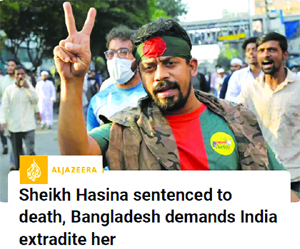
Under the heading, ‘Sheikh Hasina sentenced to death, Bangladesh demands India extradite her’, Al jazeera focused on the atmosphere in Dhaka. Security forces set up heavy checkpoints, deployed armoured vehicles and positioned troops around key government buildings. Their reporting highlighted how Hasina was accused of crimes against humanity, including authorising the use of live ammunition, drones and helicopter surveillance during mass protests earlier in the year.
It wrote that 78-year-old fugitive politician was on trial in absentia for being the mastermind and principal architect behind last year’s suppression of mass demonstration, in which some 1400 people were killed.
Under the headline, “Ex-Bangladesh leader Sheikh Hasina sentenced to death over brutal protests crackdown”, BBC wrote : “Sheikh Hasina has now been convicted by the court that she established in 2010 to try war crimes committed during Bangladesh’s 1971 liberation war.”
It also said that the verdict will put India under pressure to extradite Hasina, Bangladesh’s longest-serving prime minister, but it is unlikely to do so.
The Bangladesh government has for months been calling for Hasina, who currently resides in India, to be extradited, it added.
According to the BBC, Hasina has called the court’s decision “biased and politically motivated” in a statement released after the verdict. She was tried in her absence and has been living in exile in India since being forced from power.
Several outlets, including The Guardian, under the headline “Ousted Bangladesh PM Sheikh Hasina sentenced to death for crimes against humanity” wrote “Bangladesh’s deposed prime minister Sheikh Hasina has been sentenced to death in absentia by a court in Dhaka for crimes against humanity over a deadly crackdown on a student-led uprising last year.”
It also zoomed in that family members of killed protesters broke down in tears in the courtroom as judges handed death sentences to Hasina and the former home minister Asaduzzaman Khan, her co-accused in the trial.
The report also mentioned that Dhaka was on edge in the run-up to the decision, with security tightened across the capital and police, army and paramilitaries cordoning off the tribunal area.
In the days running up to the verdict, the capital experienced a sharp rise in political violence, including dozens of crude bombs set off across the city. The city’s police issued a “shoot-on-sight” order for anyone caught launching explosives or setting fire to vehicles.
American networks, including CBS, framed the verdict as a moment that could reshape Bangladesh’s political landscape.
Under the headline, “Bangladesh’s ousted Prime Minister Sheikh Hasina sentenced to death for crimes against humanity” CBS wrote that the interim government beefed up security ahead of the verdict, with paramilitary border guards and police deployed in Dhaka and many other parts of the country.
The tribunal also sentenced former Home Minister Asaduzzaman Khan to death in the case while a third suspect – a former police chief – was sentenced to five years in prison as he became a state witness against Hasina and pleaded guilty, it wrote.
Under the headline, “Bangladesh court sentences ex-PM to be hanged for crimes against humanity”, AFP reported that a Bangladesh court sentenced ousted prime minister Sheikh Hasina to be hanged for crimes against humanity on Monday, with cheers breaking out in the packed court as the judge read out the verdict.
Reuters under the headline ‘Bangladesh’s ousted PM Hasina sentenced to death for student crackdown’ reported that Bangladesh’s ousted prime minister, Sheikh Hasina, was sentenced to death in her absence on Monday at the end of a months-long trial that found her guilty of ordering a deadly crackdown on a student-led uprising last year.
Hasina – who fled to neighbouring India in August 2024 at the height of the uprising against her government – issued a statement dismissing the court as a “rigged tribunal”.
The interim government led by Nobel laureate Muhammad Yunus described it as an “historic verdict”, but called for calm and warned that it would deal with any disorder.