
Reform Talks: Rift deepens as parties miss govt’s ultimatum
Abu Jakir :
With just one day left before the interim government’s deadline for political parties to reach a consensus on the July National Charter, Bangladesh’s political landscape appears more divided than ever.
Instead of coming to the table, the country’s largest opposition parties — the Bangladesh Nationalist Party (BNP) and Jamaat-e-Islami — are trading threats of street mobilization and accusations of bias, raising fears of renewed confrontation ahead of February’s parliamentary elections.
The one-week ultimatum, issued by the Advisory Council of Chief Adviser Muhammad Yunus last Monday, called on all political parties to hold talks among themselves and present a unified position on the proposed referendum and reform agenda.
The Council warned that if no agreement was reached within a week, the government would “move forward on its own.
”Yet, as the deadline approaches, no formal dialogue has taken place. Instead, the week has been marked by dueling statements and political maneuvering.
On Thursday, eight Islamist political parties led by Jamaat-e-Islami submitted a memorandum to the Chief Adviser, demanding immediate implementation of the July Charter and a referendum before the upcoming general elections.
The alliance warned that if the demands were not met by November 10, it would stage a “grand rally” in Dhaka the following day.
In a latest development on Saturday, Jamaat-e-Islami and seven other parties warned the interim government not to delay the referendum by holding it on the same day as the national election.
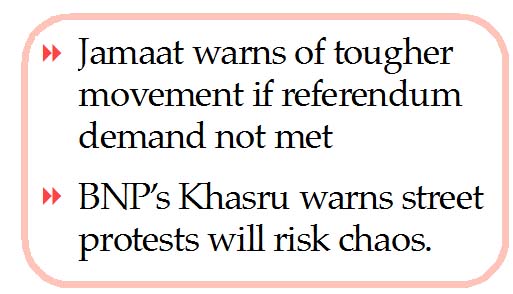
They insisted that the referendum must be conducted before the general polls and cautioned that if their demand is not met, they will announce tougher programmes during their November 11 rally.
The decision came during a meeting of the liaison committee of the eight-party alliance at the Dhaka metropolitan office of the National Democratic Party (JAGPA), according to a press release issued after the meeting.
“The people’s patience is running out,” Jamaat Secretary General Mia Golam Porwar told reporters after handing over the memorandum. “If our demands are ignored, Dhaka will look very different on November 11.”
At the same time, BNP leaders have taken a more cautious tone. Standing Committee member Amir Khasru Mahmud Chowdhury cautioned that political brinkmanship could push the country toward chaos.
“The people of Bangladesh do not want to see confrontational politics — they want stability,” he said at a discussion in Dhaka on Saturday.
“You can’t take to the streets for every issue. If one group protests and another counters it, there will be clashes. That’s not democracy.”
The BNP, while supporting the broad goals of the July Charter, has objected to the idea of holding a referendum before the election, arguing that it could be used to delay the polls.
Jamaat, on the other hand, insists the referendum must come first to give constitutional legitimacy to the reform process.
The standoff has underscored a growing fracture in Bangladesh’s opposition landscape, once united under a shared goal of ousting Sheikh Hasina’s long-entrenched government last year.
Now, the same parties are struggling to define how the country’s promised reform roadmap should move forward.
In a latest development on Saturday, BNP Standing Committee member Salahuddin Ahmed said the party was willing to join discussions if the invitation came directly from Chief Adviser Muhammad Yunus.
However, he questioned why another political party was being used to relay the call for dialogue.
“If the Chief Adviser himself invites us to discuss any issue, we are always ready to sit for talks,” Salahuddin told an event in Dhaka.
“But why are we being invited through another political party? Who are they to invite us?”
Cautioning the interim government against “overstepping its authority,” Salahuddin reminded it of its limited mandate.
“This is not an elected government. It should not act as if it has absolute power,” he said, urging the administration to focus on holding a “free, fair, and credible election” with complete neutrality.
Jamaat Assistant Secretary General Hamidur Rahman Azad, however, accused the BNP of adopting the same exclusionary politics it once condemned. “We invited the BNP to join talks, but they refused,” he said. “If the BNP calls for dialogue, Jamaat will surely go — but will others?”
At the same event, Amir Khasru warned against reopening settled debates. “We must respect the consensus that has already been achieved,” he said. “If we keep creating new issues, we are not respecting the consensus itself.”