Bangladesh’s younger generation affected by online gambling

NN ONLINE:
Online gambling claimed Mahbub’s future before it even began. At 24, he had already lost his savings, his peace, and, ultimately, his wife. What started as casual online bets for “fun” spiraled into a consuming addiction. He spent hours glued to his phone, moods swinging with every digital spin—from euphoric highs to crushing lows.
When 19-year-old Aklima was found dead at home, her family believed Mahbub had murdered her. Police records later revealed she had endured days of emotional and physical abuse from a husband eclipsed by gambling debts. Mahbub insisted it was suicide, but neighbors knew the truth: money fights over online losses had poisoned the marriage.
Mahbub’s tragedy isn’t an isolated incident. It mirrors a national epidemic—a quiet digital illness that grips smartphones and swallows the youth, one by one. The new face of addiction: Gambling used to hide in clandestine dens and whispered card games. Now it lives in every smartphone. Online gambling—what young people call betting—has become as accessible as scrolling through social feeds.
A single click opens glittering casinos, digital card rooms, and football-betting apps that promise quick riches. Flashy ads on Facebook and YouTube shout, “Play now, win big!” But for most, the payoff isn’t luck; it’s ruin.
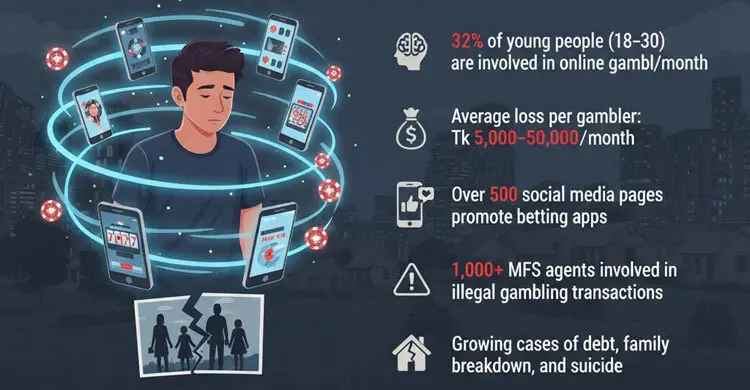
A Dhaka study shows that 32% of people aged 18–30 have engaged in online gambling. On average, each person loses between Tk 5,000 and Tk 50,000 monthly. Social media hosts more than 500 betting pages, drawing in new users daily with fake success stories and “tips.” Psychiatrists warn that this is addiction, not entertainment. Online gambling rewires the brain like drugs do, delivering dopamine hits with wins and chasing that high as losses mount.
A generation’s downfall: The patterns are heartbreakingly similar. once a bright engineering student, placed his first bet during the Euro Cup. A Tk 3,000 win felt like momentum, but 18 months later he’d lost Tk 9 lakh. “I borrowed from friends, then loan apps, then my parents,” he said. “I dropped out for two semesters.”
Sohel Rana (pseudonym), a mid-level corporate worker earning Tk 80,000, lost Tk 89 lakh—selling his wife’s jewelry, draining savings, even mortgaging their flat. “One lucky game,” he whispered, “and I thought I’d recover it. Now my wife is gone, my job is gone. I have nothing left.” In Mirpur, a mother mourns for a teenage son who told her he was freelancing, only to reveal online gambling addiction disguised as “earning apps.” He was 15.
From curiosity to despair: Experts say most gamblers start out of curiosity or peer influence. Apps offer a small win to hook players, and losses soon multiply. Rajmul Hasan, a university student, recalls: “One night I won Tk 9,000 from Tk 2,000. I felt invincible. Later I lost Tk 2 lakh my father gave me to deposit in the bank. I ruined my family’s trust for a few clicks.”
An investigation by Jago News found local agents running gambling networks across towns, processing transactions through mobile financial services. These agents earn millions while victims—often students, farmers, and small traders—slip into destitution.
A digital epidemic: The CID has identified more than 1,000 MFS agents involved in online gambling. Cyber Crime units are pursuing cases under the Cyber Security Ordinance 2025, with penalties including up to two years in jail or a Tk 1 crore fine.
CID officials say the trap isn’t just urban anymore—it has spread to rural areas. People, driven by greed, are losing savings, homes, and livelihoods. Online gambling also heightens cross-border money-laundering risks. Investigations are ongoing, and a major crackdown is looming.
But enforcement is hard. Gambling platforms are often hosted abroad and accessed via VPNs. Bail is common after lengthy investigations, even when rings are uncovered. “This is a cross-border network,” a prosecutor noted. “If police could file reports within 72 hours, many wouldn’t get bail. But cases drag on, and new rings emerge.”
A social disease: Sociologists describe online gambling as a social cancer, eroding moral foundations. Youths chase quick money rather than hard work, a shift thinkers warn is dangerous for society.
Psychiatrists report consequences beyond money—anxiety, depression, domestic violence, and suicide. “We’re seeing patients who act like drug addicts—trembling, lying, stealing,” a doctor said. “The drug is invisible—it’s in their phone.”
The state’s struggle: The government has launched a multi-agency crackdown. The BTRC has blocked hundreds of gambling sites and warned media outlets promoting betting ads to expect shutdowns. “BTRC cannot do this alone,” the chairman said. “We’re coordinating with banks, mobile operators, and cyber units. Every agency must work together to win this battle.”
The ICT Division adds that ending gambling is more than a technical challenge—it’s a social movement. Awareness must become a national priority to shift mindsets.
A generation on the brink: Behind every glowing screen, countless young Bangladeshis chase illusions—betting, losing, searching for a quick fix. For every success story, there are thousands like Mahbub, Sohel, or Rifat—lives broken, families torn apart. Online gambling isn’t just stealing money; it’s stealing futures. It turns ambition into addiction and hope into hopelessness. As one psychiatrist put it, “This isn’t just a digital problem. It’s a moral collapse, one notification at a time.”