
Industry-academia collab crucial to cope with AI, 4IR challenges: DCCI
Business Report :
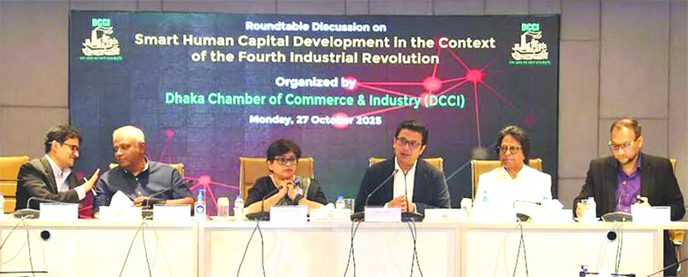
Modernization of overall education system in Bangladesh along with expansion of technical and vocational education programmes, ensuring adequate budgetary allocation, providing necessary training to meet the challenges of the AI and Fourth Industrial Revolution (4IR), speakers at a roundtable discussion organized by the Dhaka Chamber of Commerce and Industry (DCCI) said on Monday.
They also emphasized on strengthening coordination among relevant government agencies and fostering stronger industry-academia collaboration for developing skilled human resources to cope with the rapidly changing economic activities.
The discussion, titled “Smart Human Resource Development in the Context of the Fourth Industrial Revolution,” was held on Monday at the DCCI auditorium.
Nazneen Kauser Chowdhury, executive chairman of the National Skill Development Authority (NSDA), attended as the chief guest.
In his welcome remarks, DCCI President Taskin Ahmed said that the Fourth Industrial Revolution is transforming production systems, businesses, and labour markets – especially through the impact of artificial intelligence (AI).
Citing the World Economic Forum, he noted that nearly a quarter of current jobs will change within the next five years.
“Smart, technology-oriented human resources will be Bangladesh’s key strength in the post-LDC era,” he added, emphasising reforms in education and closer links between academia and industry.
Nazneen highlighted the need for better coordination among government training agencies and greater awareness about skill development, saying the NSDA has initiated programmes to teach Japanese language skills in preparation for sending 100,000 skilled workers to Japan, and emphasised women’s skills training.
Presenting the keynote paper, M Niaz Asadullah, visiting professor of Economics at the University of Reading, UK, said a 2019 A2i and UNDP study projected that by 2030, about 5.38 million jobs in Bangladesh’s RMG, food, agriculture, furniture, and hospitality sectors may be displaced due to automation.
He called for enhanced technical education and increased budget allocations for skill development.
Mahtab Uddin Ahmed, president of The Institute of Cost and Management Accountants of Bangladesh (ICMAB), underscored the importance of promoting technical education and changing the societal mindset towards vocational training.
In the open floor discussion, DCCI former Vice-President M. Abu Hurairah emphasized on sending skilled manpower abroad to boost inward remittance flow and called for expansion of technical education programmes.
Other discussants included representatives from BUET, East West University, NSDA, Bangladesh Hi-Tech Park Authority, ICMAB, British American Tobacco, Transcom Group, and Brain Station 23.
They stressed modernizing education, promoting technical and vocational training, and aligning academic curricula with industrial needs.
Participants also proposed creating a national council to coordinate training initiatives and monitor outcomes.