
Bangladesh faces huge gap in mental health services
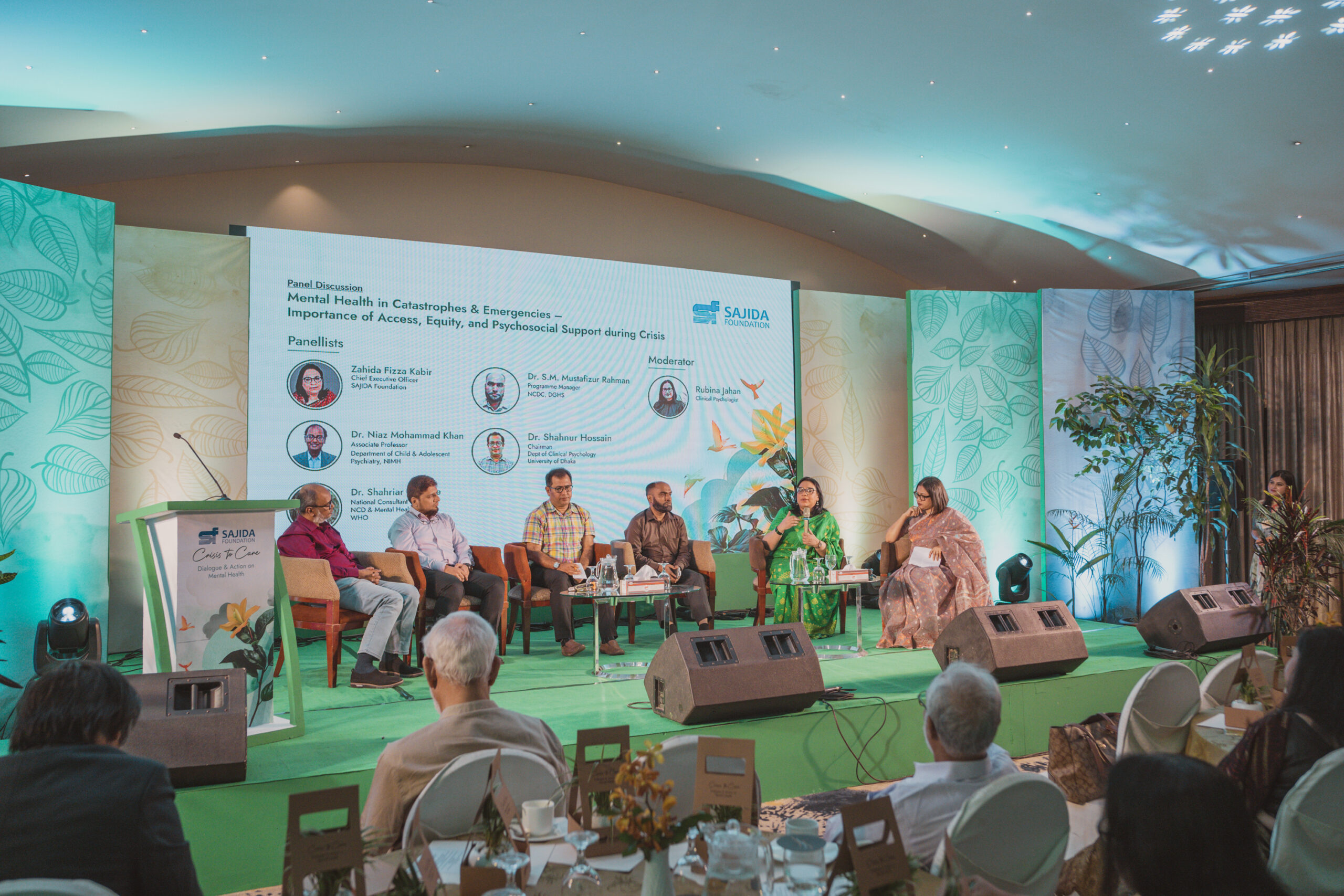
Dhaka, October 2025: Communities facing crises often struggle with long-term emotional and social impacts that slow down recovery and weaken resilience. Integrating mental health and psychosocial support into Bangladesh’s emergency preparedness and responses can address these challenges by enabling faster recovery and building stronger, more resilient communities, say experts. They made the suggestion while speaking at an event titled “Crisis to Care: Dialogue & Action on Mental Health” held on Saturday evening (October 25) at a hotel in the capital. SAJIDA Foundation organised the dialogue marking the World Mental Health Day 2025, which falls on October 10. The experts pointed out that though Bangladesh has made progress in emergency management, psychological support often remains underprioritised in the country of over 170 million population — with around 28 million of them suffering from mental health challenges. According to data presented at the dialogue from the Bangladesh WHO Special Initiative for Mental Health Situational Assessment (2020), the country faces severe mental health services gap, with only 1,525
professionals – 260 psychiatrists, 565 psychologists, and 700 nurses who provide specialty care related to mental health – struggling to meet the needs of the nation.
The event, which featured two panel discussions – one titled "Mental Health in Catastrophes & Emergencies – Importance of Access, Equity & Psychological Support During Crisis" and the other "Pathways & Barriers to Services in Emergencies – Ensuring Mental Health Support in Times of Crisis" — brought together experts, policymakers, healthcare professionals, and development practitioners to highlight the need for integrating mental health into emergency preparedness. In her opening remarks, Zahida Fizza Kabir, the Chief Executive Officer of SAJIDA Foundation, said mental
health should not be an afterthought in the event of disasters, rather it should be integrated into disaster response so that appropriate services can be provided whenever necessary.” Highlighting the financial and human resource constraints in mental health services, she urged all stakeholders, including the government, private sector, NGOs, and development partners to work together to ensure access to quality mental health care for all, especially during crises. She, however, underscored the need for a single regulatory body in mental healthcare under which all actors will function in accordance to a common standard operating procedure (SOP) that will follow a better outcome.
Directorate General of Health Services (DGHS) Program Manager Dr SM Mustafizur Rahman laid emphasison allocation of higher share of financial resources, multisectoral collaboration, and decentralisation of facilities for expanding mental health services.
Highlighting resource constraints, he said that only 0.5 percent of total health budget goes to mental health services and most of that amount is allocated as institutional budget.
Other experts attending the discussions included Dhaka University’s Clinical Psychology Department Chairman Dr Shahanur Hossain, National Institute of Mental Health’s Associate Professor Dr Niaz Mohammad Khan, WHO’s National Consultant for NCD & Mental Health Dr Shariar Faruque, SAJIDA
Foundation’s Deputy CEO MD Fazlul Haque, Plan International’s Advisor Syed MD Nuruddin, UN Women’s Coordination & Partnerships Analyst Syeda Samara Mortada and UNICEF’s Health Manager Dr Dewan MD Emdadul Hoque. Participants also visited booths of SAJIDA’s social enterprises (Psychological Health and Wellness Care Limited, Inner Circle Private Limited, Neuroscience and Psychiatry Hub Limited, Home and Community Care Limited) working on mental health and experienced an inspiring art exhibition that reflected creative expressions around lived experiences and mental well-being, along with a guided mindfulness activity, and a soulful musical performance — reminding us that resilience means caring for both body and mind. Through “Crisis to Care”, SAJIDA Foundation reaffirmed its mission to bridge the gap between crisis response and long-term mental health care, advocating a holistic, inclusive approach that prioritises human dignity and well-being.