
EC to consider 8-day deployment of security forces during polls
Staff Reporter :
The Election Commission (EC) is reviewing a proposal to extend the deployment of law enforcement agencies, including the armed forces, to eight days instead of the traditional five during the 13th parliamentary election scheduled for early February next year.
“Normally, the deployment programme lasts five days, but a proposal has been submitted to extend it to eight days.
The plan is to deploy forces three days before the polls, on polling day, and four days after the election.
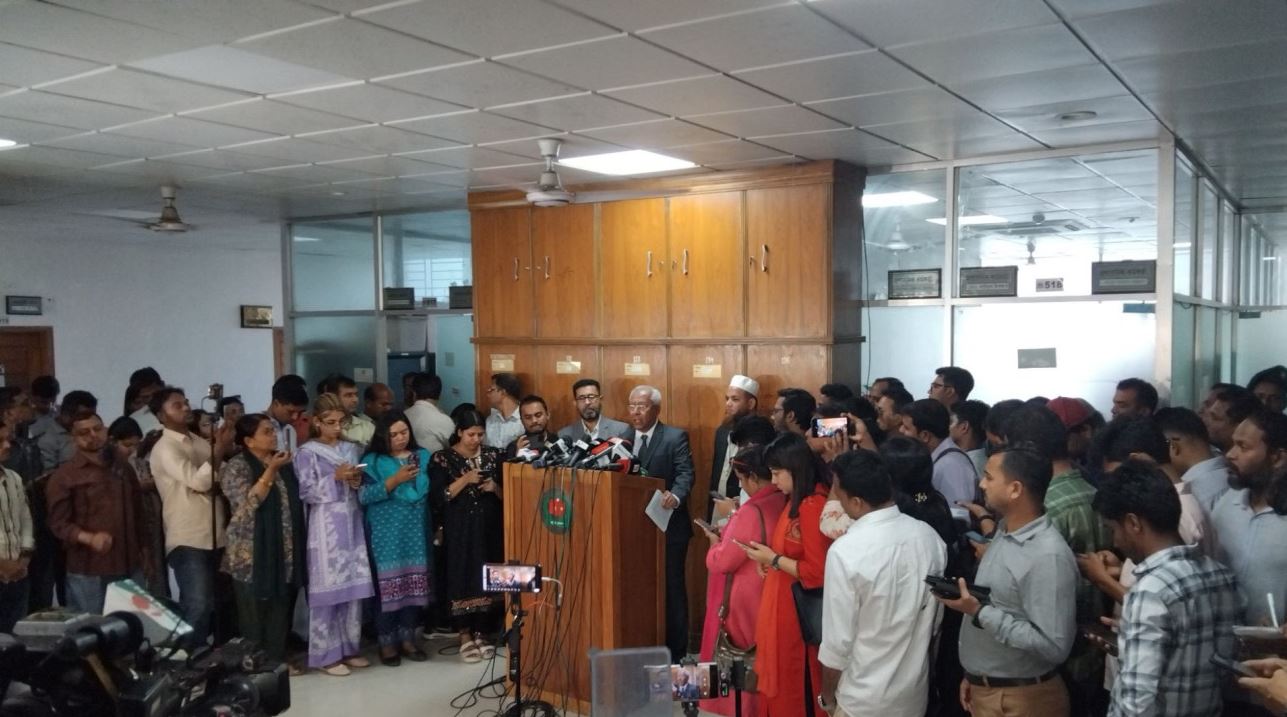
Our initial plan was for five days, but this eight-day proposal has now been tabled and will be examined,” EC Senior Secretary Akhtar Ahmed said on Monday.
He made the remarks after a views-exchange meeting with various law enforcement agencies, the armed forces, and intelligence officials aimed at ensuring the election is conducted in a free, participatory, and fair manner.
He added that approximately 90,000 to 100,000 army personnel are expected to be deployed, alongside around 150,000 police members. The deployment will also include between 500,000 and 600,000 members of Ansar and Village Defence Party (VDP).
The issue of whether the armed forces will operate under “aid to civil power” or as part of election-specific law enforcement will be finalised after amendments to the Representation of the People Order (RPO). “This will be clarified once the RPO is amended,” EC Secretary said.
The three-hour-long meeting, titled “Views-exchange and pre-preparation meeting on law and order,” took place at the Conference Room of Nirbachan Bhaban chaired by Chief Election Commissioner AMM Nasir Uddin.
Representatives from the Army, Navy, and Air Force, the Public Security Division of the Home Ministry, Armed Forces Division, Police Headquarters, and heads of the BGB, RAB, Coast Guard, Ansar-VDP, DGFI, NSI, NTMC, SB, and CID attended the session.
The discussions focused on a wide range of issues, including security at polling stations, protection of election officials, coordination among field-level forces, prevention of illegal arms, control of licensed weapons, monitoring of artificial intelligence misuse, curbing misinformation and propaganda on social media, and providing security for foreign journalists, observers, and monitoring agencies.
Ahmed also stated that drone use by the general public during the election will be prohibited, although law enforcement agencies may use drones if necessary for maintaining security.
He said the discussions are ongoing and aimed at consolidating the election environment. “Of course, there is an environment conducive to elections, and today’s discussion is to further strengthen that,” he added.
The meeting also addressed the recovery of looted arms during the July unrest, with officials reporting that 85 percent of the weapons have been retrieved, while recovery operations continue for the remaining arms and ammunition.
Additional measures include equipping police with body-worn cameras and ensuring a coordinated command structure tailored to different operational areas, such as border regions and coastal zones.
Army Aviation and Air Force Aviation have been tasked with transporting election materials by helicopter, with all helipads prepared for the operation.
Budgetary provisions for each participating agency were also discussed to ensure smooth execution of responsibilities during the election period.
Preparations for the 13th National Parliamentary polls are progressing steadily.
Updates to the voter list and constituency demarcation have been completed, while ongoing tasks include political party registration, preparation of voter list CDs, and finalisation of polling stations.
The EC emphasised that law and order before and after the schedule announcement, a peaceful electoral environment, and robust administrative readiness are critical to a credible election.
In addition, the EC has decided to ban drone use during the upcoming polls citing privacy violations, security risks, breaches of law, and potential theft of personal information.
The paper highlighted that uncontrolled drone activity could disrupt law and order, undermine the credibility of the electoral process, and potentially carry dangerous objects.
It outlined the three-stage role of law enforcement agencies: prior to the election schedule announcement, from announcement to polling day, and post-election to maintain security and prevent unrest.
Executive and Judicial Magistrates, alongside the Election Investigation Committee, will conduct summary trials if necessary.
The EC reaffirmed its commitment to ensuring a safe, transparent, and well-coordinated electoral process through extensive planning, law enforcement deployment, and administrative readiness.