
July Charter signed amid protests and boycott by July heroes
Abu Jakir :
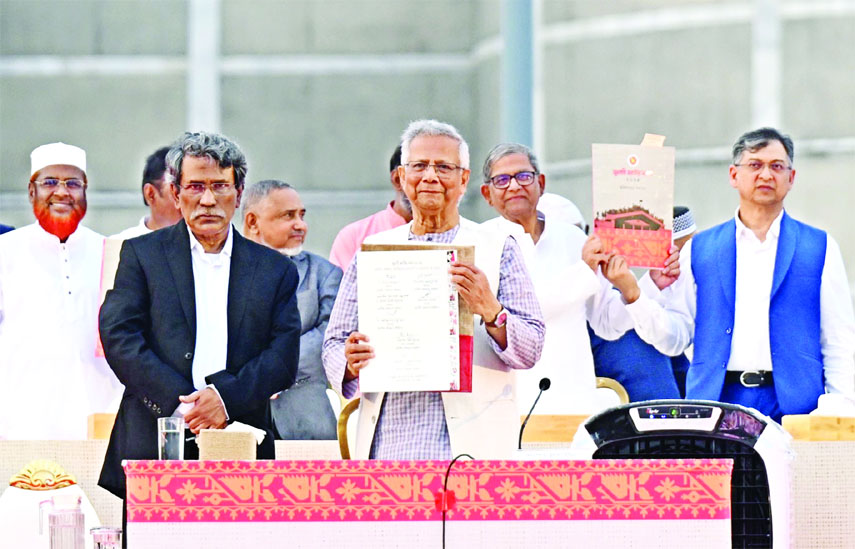
The historic signing of the July National Charter, meant to symbolize a new political beginning for Bangladesh after the fall of the long-entrenched fascist regime, unfolded on Friday under clouds of discord, protest, and exclusion.
The ceremony, held at the South Plaza of the Jatiya Sangsad Bhaban, was attended by representatives of 25 political parties.
Yet conspicuously absent was the National Citizen Party (NCP) — the principal political group born out of the July 2024 uprising, whose members led the street revolt that ended nearly 17 years of autocratic rule.
The NCP’s boycott has cast a shadow over what organizers had hoped would be a moment of national unity.
“The signing of this so-called National Charter is a betrayal of the nation in the name of consensus,” said Nahid Islam, the NCP’s convener, speaking at the inaugural event of an allied organization, Jatiya Sramik Shakti, in Dhaka’s Eskaton area on October 17.
Nahid argued that true unity cannot be forged by political maneuvering but through “the solidarity of ordinary people who fought and suffered together.”
He added that the newly formed workers’ platform would seek to build a politics of “human dignity and liberation,” particularly for those who endured oppression under Sheikh Hasina’s regime.
Other NCP leaders were equally critical. July hero Sarjis Alam told reporters that the interim government appeared eager to rush toward elections without ensuring the legal or moral implementation of the Charter.
“This entire process is being reduced to symbolism,” he said.
The National Consensus Commission, which oversaw the drafting and signing of the July Charter, confirmed participation by 25 parties out of the 30 that had joined preliminary dialogues.
Among those present were delegations from the Bangladesh Nationalist Party (BNP), Bangladesh Jamaat-e-Islami, the Liberal Democratic Party (LDP), Khelafat Majlis, Rastro Songskar Andolon, Amar Bangladesh Party (AB Party), and Nagorik Oikya.
BNP’s delegation was led by Secretary General Mirza Fakhrul Islam Alamgir and Standing Committee member Salahuddin Ahmed. Jamaat-e-Islami was represented by Central Nayeb-e-Ameer Dr. Syed Abdullah Mohammad Taher and Secretary General Mia Golam Porwar. The LDP delegation included Secretary General Dr. Redwan Ahmed and Presidium Member Dr. Neyamul Bashir.
Four left-leaning parties — the Communist Party of Bangladesh (CPB), Bangladesher Samajtantrik Dal (Basod), Basod (Marxist), and Bangladesh Jasod — also abstained, citing concerns about inclusivity and the lack of structural reform commitments in the final document.
BNP Standing Committee member Dr. Abdul Moyeen Khan said the Charter’s legitimacy was fundamentally undermined by the absence of the July movement’s main actors.
“Any national charter will lose its meaning if those who led the uprising are not part of it,” he said, describing the current political situation as “deeply undesirable.”
As dignitaries signed the Charter under the autumn sun, tensions were mounting outside the Parliament complex.
A group of self-identified July heroes and relatives of slain protesters clashed with police in front of the South Plaza, demanding recognition and rehabilitation under a proposed July Protection Act.
Witnesses reported baton charges, vandalism of vehicles, and sporadic explosions. Several protesters were injured and later taken to hospitals.
Later in the day, the National Consensus Commission announced an amendment to the Charter’s fifth clause — a section that had sparked widespread anger among July fighters and their families.
The revised version explicitly blamed the “fascist Awami League and its allied law enforcement forces” for killings during the July–August 2024 uprising and promised state honors, financial support, and legal protection for the “July martyrs and heroes.”
Jamaat-e-Islami Ameer Dr. Shafiqur Rahman called the police action on the July heroes “shameful,” saying, “It is disgraceful that July fighters had to take to the streets and were beaten by the interim government’s police even on the day the Charter was signed. Many others’ demands are being heard — yet they are being deprived. This is not justice.”
The day that was meant to enshrine the spirit of a people’s revolution instead laid bare the fractures of a fragile new order — one struggling to balance the weight of memory with the urgency of political transition.
Whether the July Charter becomes a living covenant or a symbolic document will now depend on whether those who fought for change are finally given a voice in shaping the future they helped create.