Sand extraction from Jaintapur River: Cemetery-Residential house in danger of erosion

S A Shofiee, Sylhet:
After the Bholaganj incident in Sylhet, illegal extraction of stones and sand has come under control to a large extent due to the increased surveillance of the concerned authorities. However, illegal extraction of sand from the Rangpani Napitkhal river in Jaintapur is still rampant.
It is learned that due to the frequent raids and various steps taken by the administration, work is being carried out in most of the sand pits across Sylhet in a controlled manner. The only exception is Jaintapur. There, illegal sand extraction is going on from the Lakshmipur village area of the Napitkhal river. Due to which, the villages along the riverbank, two rural roads, houses, cropland and a cemetery are under threat of erosion. Residents on both sides are spending their days in anxiety over river erosion. No one dares to protest for fear of the influential people in the sand pits.
According to district administration sources, although three sand pits have been leased in Jaintapur, none have been leased in the Rangpani River. Recently, the upazila administration has started a campaign against sand extraction outside the lease. Local influential people have started extracting sand again in the Napitkhal River of Rangpani.
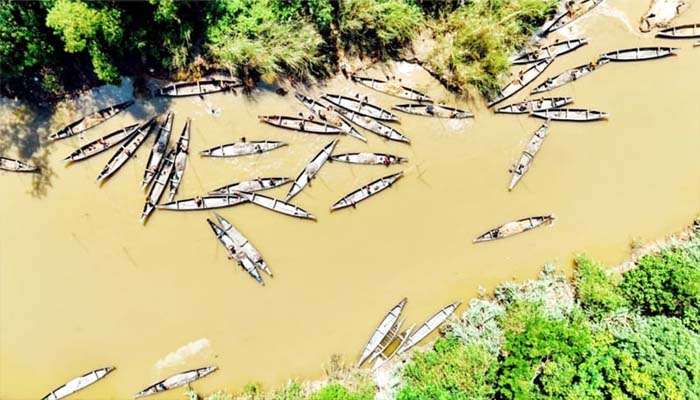
A visit to the riverbank area on the spot shows that more than a hundred barque boats are entering the main river every day along the narrow part of the Napitkhal River to evade the administration. The workers on these boats, with the help of sand workers, are taking the illegally extracted sand for sale. It is alleged that those controlling the illegal sand business in the area along the riverbank that is outside the lease are also collecting a bribe of 1,000 taka per boat from those workers.
Several local sources have alleged that Jamal Molla, Abdul Quddus, Abdus Salam, Humayun Molla, Hasan Ahmed, Imran Hossain, and several influential people from Lakshmipur are involved in the looting of sand from the Napitkhal River.
Locals allege that due to illegal sand mining, there is a risk of erosion in several parts of the coastal villages. Several structures including local homes, rural roads, croplands, and cemeteries are under threat.
Meanwhile, locals have said that the tendency of river erosion during floods can become extreme due to sand mining. Earlier, several homes in this area were submerged in the river due to river erosion in the 2022 flood. Since influential people are involved in sand mining, the people of the village do not have the courage to protest.
A student from the village, who did not want to be identified, said that two rural roads and a cemetery are on the verge of disappearing. If this continues, the entire village will be under threat.
Regarding the allegations, Abdus Salam said that he has no involvement in sand mining or sand trading. He said that fabricated information is being spread against him.
Meanwhile, when asked about the collection of a fee of 1,000 taka from each boat, another accused, Humayun Molla, did not want to say anything. In addition, when asked whether the part of the river from which sand is being extracted is under lease by the administration as a sand market, Hasan Ahmed knew, but he did not know anything about it. However, Jamal Molla knows everything about it.
In this regard, local UP member Nazir Ahmed said that illegal sand mining has been banned. If someone builds a house in his area, someone might take it. However, he demanded that action be taken against those who are extracting sand for sale.
Stating that he was not aware of the issue of sand mining in the area, the UP member said that houses and roads in the area are being damaged due to sand mining in the river and the movement of steel or engine-powered boats. He does not have specific information about sand mining.
Regarding sand mining in the Napitkhal River, Jaintapur Upazila Executive Officer (UNO) George Mitra Chakma said, “So far, they have been able to control illegal sand mining in almost all the notable places in Sylhet. The administration’s surveillance and field-level operations are continuing in this work. Now, if anyone enters the river again, action will be taken against them.”