
Stakeholders call for stronger child protection
Staff Reporter :
A national seminar on preventing child abuse and exploitation, and promoting child protection mechanisms for the children of garment workers, was held in the capital on Monday.
Bangladesh has a population of around 160 million, of which more than 64 million-about 40 percent-are children. In the absence of strong community-based child protection mechanisms, many of them remain exposed to risks that threaten their safety, development, and growth.
As a result, children continue to face abuse and exploitation. According to a report published on September 14, 2025, incidents of abuse against girls have increased by 75 percent compared to the previous year, while 306 children were exploited in the last seven months alone.
The observation came during an event, jointly organised by Terre des Hommes Netherlands, Village Education Resource Center (VERC), and Breaking the Silence (BTS) in a city hotel.
The seminar showcased role models and best practices developed under the three-year project Community-Based Child Protection Mechanism for the Children of Garment Workers in Bangladesh (CBCPM Project). The project, launched in October 2022, is set to run until September 2025.
Md. Saidur Rahman Khan, Director General of the Department of Social Services, said children remain highly vulnerable.
“Our children face sexual and physical abuse, both visible and invisible, including risks from online exposure,” he noted.
He urged replication of best practices developed under the project, adding: “The government will help disseminate these models. We are also taking steps to prevent adolescent gangs, but this requires joint efforts of government and non-government actors.”
Zabed Hossain Bhuiyan, Director of Padma Apparels Industry and Chair of the BGMEA Standing Committee, stressed that child protection is vital for industry performance and worker productivity.
“When workers know their children are safe, they can focus on productivity and skill development,” he said. “Mindfulness and decent workplaces will also strengthen Bangladesh’s position in global markets.”
Presenting the concept paper, Nurul Kabir, Program Coordinator of TdH Netherlands and focal person of the CBCPM project, said millions of children in Bangladesh are deprived of their right to identity.
“There are 102 child courts, but more than 23,000 juvenile cases remain pending. Compared to last year, incidents of abuse against girls have risen by 75 percent, while 306 children have been victims of violence in the first seven months of this year,” he said.
Quoting UNICEF, he added: “Nine out of ten children aged one to 14 face physical punishment or psychological abuse, often by parents, teachers, or guardians.
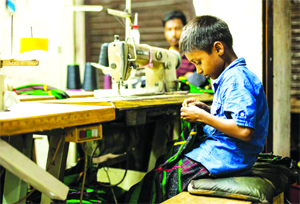
About seven percent of children aged five to 17 are engaged in child labor, with many very young children working in hazardous conditions. The most neglected among them are the children of garment sector workers.”
Naima Hossain, Director (Joint Secretary) of the Department of Women Affairs, highlighted the need for collaboration.
“No single entity can prevent child abuse,” she said. “Coordinated action is essential. We already run 43 daycare centers, with 20 more projects underway and seven new centers opening soon.”
She added that global industry practices show the benefits of holistic approaches, where factories support workers’ families as well.
“Such models can be replicated in Bangladesh with the support of local philanthropy and organizations,” she said.
Nurul Kabir, Program Coordinator of TdH Netherlands and focal person for the CBCPM project, said child protection is most urgent for working parents.
“When parents are in factories, children need safe spaces,” he said, pointing to new early learning centers that provide education and care.
Mabrub Mohammad, Adviser at Ain o Salish Kendra, cautioned that abuse affects both girls and boys. “Online sexual harassment is rising but reporting remains low,” he said.
He called for holistic initiatives involving government, schools, communities, and religious leaders.
The participants also shared their experiences from the field, highlighting both the challenges faced by children of garment workers and the practical solutions that have emerged through community-based initiatives.