
UNGA Speech: CA Yunus vows citizen-centered reforms ahead of February polls
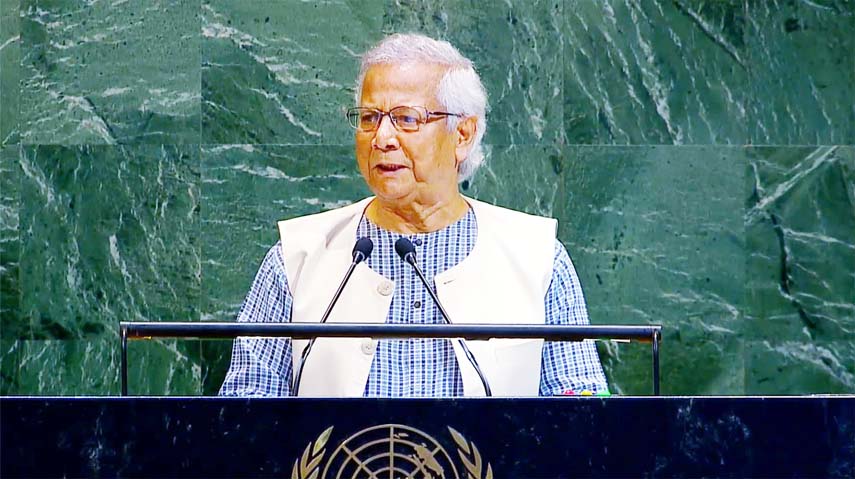
Staff Reporter :
Chief Adviser Muhammad Yunus on Friday reaffirmed the interim government’s resolve to pursue reforms that put citizens first.
Speaking at the General Debate of the 80th UN General Assembly in New York, he said: “As we prepare for national elections in February, we remain steadfast in advancing reforms anchored in transparency, accountability, and the rule of law.”
He recalled Bangladesh’s long struggle for equality, dignity, and justice since 1971, stressing that citizens’ rights have often been denied but repeatedly reclaimed-most recently during the July Uprising led by youth.
Yunus said the interim government had taken responsibility for rebuilding institutions through inclusive reforms, not unilateral orders.
Eleven independent commissions were formed on governance, justice, elections, law enforcement, anti-corruption, and other sectors, with citizens directly consulted.
A National Consensus Commission then brought together over 30 political parties to endorse the July Declaration, ensuring reforms would outlast electoral outcomes.
He congratulated Annalena Baerbock on assuming the UNGA presidency, pledged Bangladesh’s full cooperation, and noted the UN Charter’s 80th anniversary as a reminder of both the organisation’s indispensability and its shortcomings in resolving conflicts.
Highlighting reforms, Yunus said Bangladesh had invited the UN Human Rights Commissioner to investigate past abuses, acceded to conventions against enforced disappearance and torture, and accepted a three-year OHCHR mission.
He pledged accountability-driven development, citing the uncovering of massive corruption under the former regime and urging host countries to repatriate stolen assets.
Economic reforms, he said, include overhauling revenue systems, adopting a market-based exchange rate, disciplining banks,
modernising procurement, and improving port logistics.
He credited migrant workers’ remittances for sustaining the economy and pressed host countries to safeguard their rights. Labour reforms now extend maternity benefits, strengthen unionisation, and broaden social protection.
On youth, Yunus called them Bangladesh’s greatest asset, with investments in AI, renewable energy, and innovation aimed at turning them into job creators. A UN-backed youth platform is being launched to connect them with policymakers.
He warned of risks from the digital divide but argued that social innovation, like microcredit, can be as transformative as technology.
He identified climate change as humanity’s gravest threat, urging delivery of climate finance pledges and support for locally led adaptation. He criticised protectionism, called for fair global trade, and demanded pressure on Myanmar to end the Rohingya crisis.
On global security, he urged nuclear disarmament, stronger arms control, and nuclear-free zones in South Asia and the Middle East, noting Bangladesh’s adherence to IAEA safeguards. He described the situation in Gaza as genocide and pressed for a two-state solution with East Jerusalem as Palestine’s capital.
Yunus reaffirmed Bangladesh’s strong role in UN peacekeeping, warning that disinformation, hate speech, and AI-driven deep fakes threaten global stability.
He underscored women’s empowerment, citing unpaid household work’s economic value and pledging laws on harassment, recognition of unpaid labour, stronger gender budgeting, and wider political participation for women.
Regionally, he said Bangladesh seeks deeper integration through BIMSTEC, BBIN, and SASEC, while pursuing ASEAN membership and SAARC revitalisation. He stressed fair sharing of natural resources, including under the UN Water Convention.
On the global stage, he urged renewed commitment to the SDGs, called for smoother LDC graduation, and promoted social business as a sustainable development model.
Concluding, Yunus said multilateralism remains humanity’s last safeguard despite strains. Welcoming the UN80 initiative, he urged reforms that empower, not sideline, developing countries, and called on the youth to lead humanity toward “three zeros”: zero carbon, zero wealth concentration, and zero unemployment.