
Hilsa prices soar beyond reach
Muhammad Ayub ALi :
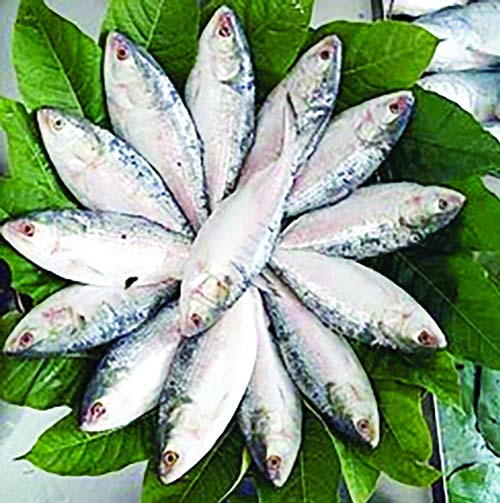
Despite being in the peak hilsa season, prices of hilsa fish have skyrocketed in Dhaka’s Jatrabari wholesale and retail markets, where a kilogram is currently selling for Tk 2,300–2,500.
Due to the price soaring this year’s Hilsa fish out of reach not only for low-income families but also for many middle-income households, who once saw hilsa as a symbol of cultural pride and tradition on their dining tables.
Fish traders attribute the steep hike to rising transportation costs, middlemen profiteering, and high consumer demand outstripping limited supply, despite reports of a relatively good catch in major hilsa hubs such as Chandpur, Barishal, and Patharghata.
Medium-sized hilsa in those areas still command Tk 1,700–2,000 per kg, leaving little room for price relief in Dhaka after transport, storage, and retail markups.
Bangladesh harvested 529,000 tons of hilsa in FY 2023–24—about 42,000 tons less than the previous year. Fishermen’s leaders blame weak enforcement during the mother hilsa and jatka preservation campaigns, illegal fishing during the ban, and administrative failures.
“During last August’s political unrest, the ban was not properly enforced. Later, monitoring slackened further,” said Md Iqbal Hossain, Secretary General of the National Fishermen’s Association.
Officials admit capacity gaps. “We lack manpower and technology to monitor round the clock.
Some unscrupulous traders continue to catch hilsa even during the ban,” said M Faruk Moeduzzaman, Assistant director of the Department of Fisheries’ Hilsa Branch.
Although the fishing ban ended on June 11, prices climbed further instead of easing. Chandpur DC Mohammad Mohsin Uddin confirmed syndicate manipulation during auctions.
In contrast, Chandpur Matsya Banik Samiti leader Shabe Barat pointed to higher input costs—nets, boats, and fuel—as justification for the surge.
The price of hilsa has skyrocketed 324 percent in a decade—from Tk 590 per kg in 2015 to Tk 2,500 in 2025.
“Hilsa is a wild-caught fish. Unlike pangasius or rui, it is not farmed. So why such a steep hike?” questioned Dr Md Anisur Rahman, former DG of the Bangladesh Fisheries Research Institute.
Though the government has pledged measures—pricing frameworks, warehouse upgrades, and tech-based surveillance—progress remains limited.
Chandpur’s local drives have yet to bring visible results.
“Simply announcing prices won’t work.
We must address the root causes,” said Fisheries Ministry adviser Farida Akhtar. She pointed to river navigability issues and stressed the need for tougher action against illegal nets.
Experts recommend satellite and drone-based monitoring during bans, transparent digital auctions, and reform of the licensing system to dismantle syndicates. Without urgent steps, they warn, hilsa may soon be a luxury item.
“Hilsa is not just a fish—it’s part of our identity. If it goes beyond the reach of ordinary people, it will wound our heritage,” said Information Ministry official Mizanur Rahman.
In Jatrabari, Siraj Rahman gazed at a one-kg hilsa priced at Tk 2,400, his son tugging at his sleeve.
“We can’t afford it,” he sighed. “Hilsa is more than food—it is a memory, a tradition. If this silver fish becomes a dream, a bright piece of our culture will be lost.
The state must step in, break the syndicates, and return hilsa to the people.”