Fair Polls: EC commits reviewing media guidelines

Staff Reporter :
The Election Commission (EC) on Thursday assured that it would review and, if necessary, amend its guidelines for journalists covering the next general election, acknowledging that media cooperation is critical for ensuring transparency.
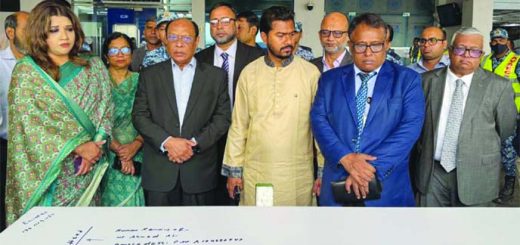
The assurance came during a views-exchange meeting between the Election Commission and the Reporters Forum for Election and Democracy (RFED), held in Dhaka. Journalists present at the event demanded revisions to the “Guidelines for Journalists/Media Personnel Assigned to Cover Election News 2025”, a document the EC had issued in July in preparation for the 13th parliamentary election, which is scheduled for early February 2026.
Election Commissioner Abdur Rahmanel Masud emphasised the indispensable role of journalists in fostering a credible electoral process. “We all want a transparent election. For this, your cooperation is extremely important. No wrongdoing will be patronised. We may make mistakes, but we will not tolerate any injustice. So, we seek your cooperation,” Masud told the gathering.
Responding to RFED’s written demands for changes in the guidelines, Masud said the commission would carefully examine them. “We’ll do whatever is best for both sides, for the people, and for holding a fair and transparent election,” he assured. He also pledged to act in the best interests of journalists, the EC, and the wider electorate after reviewing the proposed amendments to the media code of conduct.
Echoing his colleague, Election Commissioner Md Anwarul Islam Sarker acknowledged the pervasive trust deficit that has plagued Bangladesh’s electoral system. “The crisis of trust is our national crisis. I cannot say in isolation that someone is bad and I am good.
And you cannot say that I am bad and you are good. In this situation, the first thing our Election Commission is saying is that trust must be restored,” he said, urging journalists and election officials to cooperate for the greater objective of a free and fair poll.
Two other commissioners – Tahmina Ahmad and Brig Gen (retd) Abdul Fazal Md Sanaullah – and EC Senior Secretary Akhtar Ahmed also addressed the meeting. RFED President Kazi Emad Uddin Jebel presented the journalists’ proposed amendments to the guidelines, while RFED General Secretary Golam Rabbani moderated the session.
The dialogue with journalists took place a day after the EC finalised a sweeping Code of Conduct for Political Parties and Candidates, which tightens restrictions on election campaigning, including explicit provisions on the use of artificial intelligence (AI), social media, posters, and campaign materials.
On Wednesday, the EC announced that AI cannot be misused in any election-related activity, including campaigning. Candidates must submit their social media account details and related digital identifiers to returning officers before commencing campaigns. The new rules explicitly ban the creation and dissemination of fabricated election information, hate speech, personal attacks, or inflammatory content targeting women, minorities, or political opponents.
The punishment for violating the code has also been toughened: offenders now face up to six months’ imprisonment and fines of Tk 150,000, up from the earlier Tk 50,000. “The use of AI is discouraged. Nothing can be done through social media or artificial intelligence that violates the code of conduct,” Election Commissioner Abdul Fazal Md Sanaullah said at Wednesday’s press briefing.
The code of conduct introduces further environmental and logistical restrictions. Candidates are prohibited from using any posters, along with pamphlets, leaflets, festoons, or banners made from non-biodegradable materials such as plastic or polythene. Each candidate may install no more than 20 billboards per constituency, with each billboard capped at 16 feet by 9 feet in size.
The EC has also banned the use of drones, quadcopters, or similar machines during campaigns and balloting hours. Helicopters may only be used by party chiefs or equivalent leaders, and they cannot drop campaign material.
In terms of sound systems, campaign loudspeakers may only operate between 2 pm and 8 pm, and noise levels must remain under 60 decibels. Violations of these rules could result in the cancellation of candidacy.
The code further defines a list of Very Very Important Persons (VVIPs), including members of constitutional bodies, the chief adviser and advisers of the interim government, as well as the prime minister, ministers, MPs, and mayors. These VVIPs will face strict restrictions on attending election programmes or visiting constituencies during campaigns.
Election Commissioner Abdur Rahmanel Masud confirmed that the revised code of conduct had already been sent to the Law Ministry for vetting under the Representation of the People Order (Amendment) Ordinance, 2025. However, he stressed that the commission does not require further government approval to enforce the rules.