
From Uprising to Overhaul
Staff Reporter :
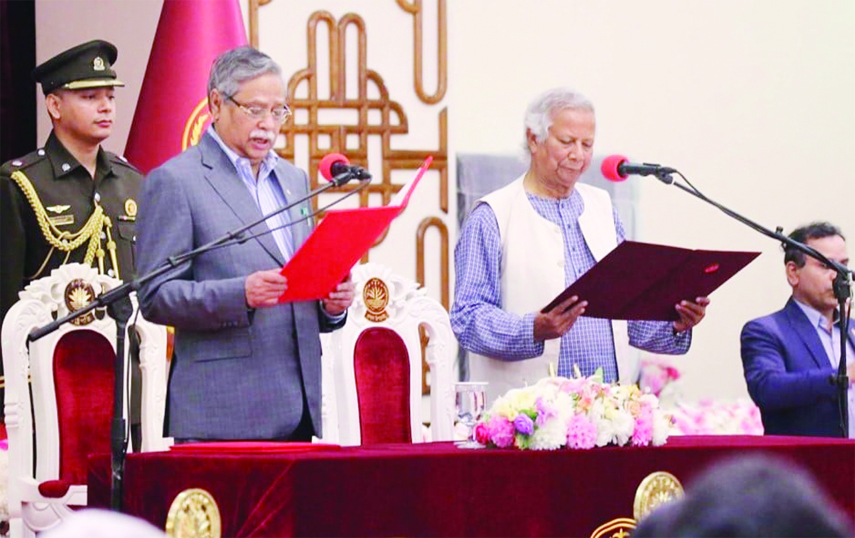
One year after Nobel laureate Professor Muhammad Yunus took the oath as Chief Adviser of Bangladesh’s interim government, his administration is marking a turbulent but transformative first year in office.
Yunus assumed leadership on 8 August 2024, just three days after a student-led uprising toppled Sheikh Hasina’s 15-year rule. The transition followed weeks of political unrest, economic uncertainty, and public distrust in state institutions. The protests – the largest mass mobilisation since 1971 – left hundreds dead and thousands injured.
From political volatility to stability
In its early months, the Yunus government focused on restoring order and preventing the cycle of political reprisals that has followed previous power shifts. Through dialogue with rival parties, amnesties for non-violent protesters, and police reforms, it avoided prolonged unrest.
On the uprising’s first anniversary this August, the administration unveiled the July Declaration, outlining safeguards against authoritarian rule. Its companion document, the July Charter, now in final drafting after consultation with more than 30 parties via the National Consensus Commission, aims to entrench checks and balances in governance.
Election preparations underway
In a televised address on 5 August, Yunus announced parliamentary elections for February 2026, before Ramadan. The Election Commission is expected to confirm the schedule in December. Plans include overseas voting rights, targeted outreach to first-time and women voters, and mobilisation of 800,000 security personnel to safeguard what Yunus has described as a “festive celebration of democracy.”
Economic recovery and investor confidence
When the interim government took charge, food inflation had reached 14 per cent, the taka was weakening, and reserves were under pressure. By June 2025, overall inflation had fallen to 8.48 per cent – the lowest in nearly three years – with a target of reducing food inflation to 6 per cent by year-end. Officials credit stricter market oversight, curbs on price manipulation, and steady imports for the improvement, despite severe floods in late 2024.
Remittances hit a record US$30.33 billion in the last fiscal year, exports rose 9 per cent, and the taka strengthened against the dollar. Foreign investment has grown, boosted by a trade deal with the US, a US$250 million textile investment from Japan’s Handa Group, and renewed interest from Chinese firms.
Reform commissions and institutional overhaul
The government has formed commissions on electoral reform, the judiciary, policing, public administration, health, labour rights, anti-corruption, and the media. Many recommendations are already in force.Judicial reforms have introduced transparent appointment processes, while police changes include human rights units, body cameras, and updated protest management protocols. Legal amendments guarantee lawyer access, prompt family notification after arrest, improved detainee medical safeguards, and digital filing of general diaries.
Press freedom and digital rights
In a break from past policy, the administration repealed the Cyber Security Act, withdrew pending journalist cases, and made internet access a constitutional right – a first for Bangladesh.
Justice for the uprising
Trials are underway for the violence of July-August 2024, including proceedings against former Prime Minister Sheikh Hasina. The government says these are legal, not political, actions.
It has also provided Tk 1 billion in savings certificates to 775 families of those killed and Tk 1.53 billion in aid to more than 13,000 injured. Severely wounded protesters have been sent abroad for treatment. The former prime minister’s residence, Ganabhaban, is being converted into a July Mass Uprising Memorial Museum, and a foundation has been created to support victims’ families.
Foreign policy diversification
The administration has sought to broaden Bangladesh’s international partnerships, deepening ties with the US, China, the EU, and regional blocs, reviving SAARC discussions, and exploring ASEAN membership. Labour diplomacy has led to resumed visas from the UAE, expanded opportunities in Malaysia, and new migration pathways to Japan, Italy, South Korea, and Serbia.
Infrastructure and maritime development
Maritime resources in the Bay of Bengal have been prioritised for a “blue economy” strategy, with port efficiency, coastal development, and deep-sea fisheries all targeted for growth.
A transitional mandate
Supporters say the Yunus government has stabilised the country and laid the groundwork for a credible election. Critics argue its true test will come in 2026 and in whether reforms endure beyond the interim period.
“We are not here to rule forever,” Yunus told the nation on 5 August. “We are here to ensure that never again can power be abused to silence a people’s voice.”