
Govt working to deliver inclusive, credible poll: CA
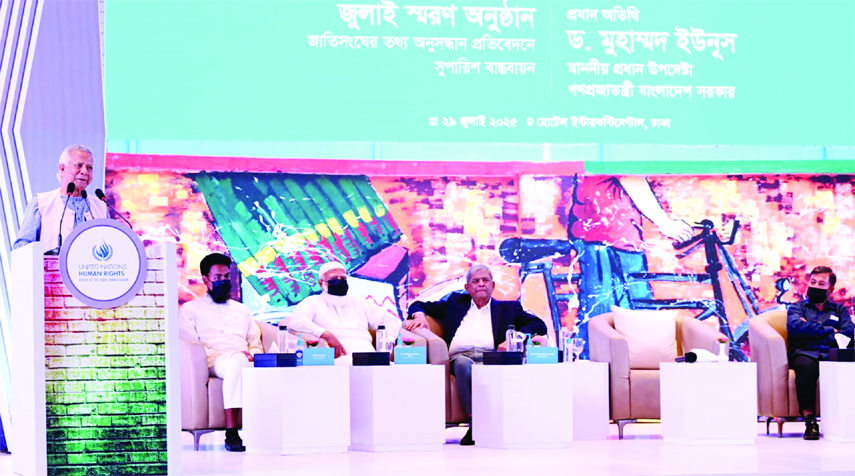
Staff Reporter :
Chief Adviser Prof Muhammad Yunus said that his government has been working to build a broad national consensus around a renewed political system – one that delivers inclusive, participatory, and credible elections.
Speaking at a UN event commemorating the first anniversary of the July Uprising and the release of a UN fact-finding report, Yunus emphasized that building a fair electoral process is essential to ensuring lasting justice, peace, and dignity for all Bangladeshis.
Addressing an audience of diplomats, civil society leaders, and UN officials at Hotel Intercontinental in Dhaka, Professor Yunus reflected on the events of July 2024, when a popular uprising ended years of authoritarian rule.
He praised the courage of the Bangladeshi people, especially the youth, for standing up to tyranny and reclaiming their rights.
“We are working to build a broad national consensus around a renewed political system-one that delivers inclusive, participatory, and credible elections,” Yunus said.
“The goal is clear: to establish a society where all Bangladeshis can live in peace, with pride, with freedom, and with dignity,” he added.
He also highlighted the government’s reform efforts, including amendments to the Code of Criminal Procedure, signing of key international conventions, and collaboration with the UN Office of the High Commissioner for Human Rights (OHCHR) to prevent future abuses.
Yunus reaffirmed his administration’s commitment to legal accountability for past atrocities, stating, “Our work is far from finished. Alongside our reform agenda, we are pursuing legal accountability for those responsible for gross violations. But justice is not only about punishment.
Justice is also about ensuring that state power can never again be used to suppress, silence, or destroy its own people.”
Reflecting the July uprising, he said, “As we reflect on this past year, we remember those who gave their lives in pursuit of that vision. Their sacrifice paved the way for a new chapter in our history. They created a new Bangladesh, one that is rooted in hope, human rights, and democratic renewal.”
“Today, we gather to mark the first anniversary of the July Uprising-a moment of profound significance in the history of our nation.
It was a moment when thousands of Bangladeshi men and women-most of them young-stood up against tyranny and reclaimed the dignity and future of our country. Their courage spoke not only for our people, but for humanity,” he added.
The Chief Adviser also thanked the international community, particularly the United Nations for its unwavering support and urged continued international engagement as Bangladesh moves toward democratic renewal.
“I thank the United Nations for standing with us in our darkest hour, and I look forward to the continued partnership as we move forward,” he added.
Defending the inalienable rights of all human beings, Nobel Laureate Dr Muhammad Yunus said, “Over the past sixteen years, these rights were repeatedly denied to our citizens. Our institutions were captured. Freedoms were curtailed. Violence became the prime tool of governance.”
“Last July, our society stood united in rejecting this reality. The people of Bangladesh reclaimed their rights with clarity, resolve, and immense bravery,” he added.
Recalling the UN High Commissioner’s report, released in February 2025, he said, the report has revealed the staggering scale of the atrocities: an estimated 1,400 lives lost in just a few weeks.
The report described the violence as systematic, directed, and coordinated from the highest levels of the previous regime. It raised urgent concerns about potential crimes against humanity, he continued.
About the setting up of OHCHR office in Dhaka, the Chief Adviser said that this Mission would provide technical support for reform initiatives, as well as capacity-building for government institutions, local authorities, and civil society actors working to safeguard most precious thing, human rights.
He also thanked Secretary-General Antonio Guterres for his unwavering support and for his solidarity and his visit to Bangladesh in March of this year and also extended appreciation to High Commissioner Volker Turk, the members of the OHCHR Fact-Finding Team, Gwyn Lewis, the UN Resident Coordinator, and Huma Khan, Senior Human Rights Adviser, for their extraordinary and historical contributions.