City suffocates under unchecked urban growth

Staff Reporter :
Once known as the city of mosques and water, Dhaka is now gasping for breath beneath the weight of unchecked urbanisation, disappearing greenery, and dying rivers, according to a new study unveiled by environmental organisation Change Initiative.
At a press conference held at a city hotel on Sunday, the organisation revealed alarming findings from its latest report titled “Dhaka Without Nature? Rethinking Sustainable Urbanism Based on Natural Rights.”
The study outlines the devastating impact of four decades of rapid, unregulated urban expansion, warning that the capital is facing an environmental emergency that threatens both its ecosystem and inhabitants.
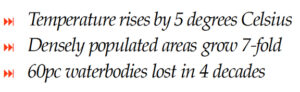
According to the report, Dhaka’s densely populated zones have expanded sevenfold since 1980, replacing trees, ponds, and open land with concrete structures and industrial zones.
Over the same period, more than 60 per cent of the city’s wetlands have vanished, while green cover has declined sharply from 21.6 per cent to just 11.6 per cent. Presently, water bodies occupy only 4.8 per cent of the city’s area.
The city’s surface temperature has increased by 3 to 5 degrees Celsius since the 1980s. Neighbourhoods such as Shyampur, Hazaribagh, Tejgaon, and Rampura have emerged as urban heat hotspots, with surface temperatures frequently exceeding 32°C, the report noted.
“Dhaka is no longer just hot – it’s hostile,” said M Zakir Hossain Khan, CEO of Change Initiative. “The air is toxic, the water is disappearing, and the city is suffocating. We are witnessing ecological injustice.”
The report identifies unplanned urban development and poor governance as the primary causes of the crisis. Massive construction, both residential and industrial, continues across the capital without adequate regulatory oversight. Currently, 37 out of 50 police precincts have exceeded safe construction thresholds.
Several neighbourhoods-including Adabor, Rampura, Kafrul, and Wari-are now described as “urban deserts” due to the near-complete absence of vegetation. Meanwhile, industrial zones such as Shyampur, Hazaribagh, Tejgaon, and Darus Salam have evolved into urban heat islands, losing their former climatic resilience.
The degradation extends to Dhaka’s rivers. The Buriganga, Turag, Balu, and Shitalakshya – once vital lifelines – are now heavily polluted, silted, and encroached upon, unable to sustain the capital’s ecological needs.