
Milestone Tragedy
Badrul Huda Sohel :
In 2011, a US Special Force helicopter unintentionally killed a number of children aged between 8 and14 in Kunar province, Afghanistan. The US general of ISAF apologized in a video message terming it a “huge mistake”.
In March this year, South Korea experienced an unusual incident- a mistaken bomb during an air force training exercise- which resulted in injuries and property damage. Following the incident, the Chief of South Korea’s Air Force, the highest-ranking official in the country’s aerial defense, immediately apologized and pledged compensation.
It is perhaps unfair to think of the same scenario in our country Bangladesh. Here, the saying ‘Forgiveness is a noble virtue’ adorns the pages of textbooks. The word ‘forgiveness’ is in no one’s dictionary, nor in any government document here. When a mishap happens in this country, all are found busy defending themselves.
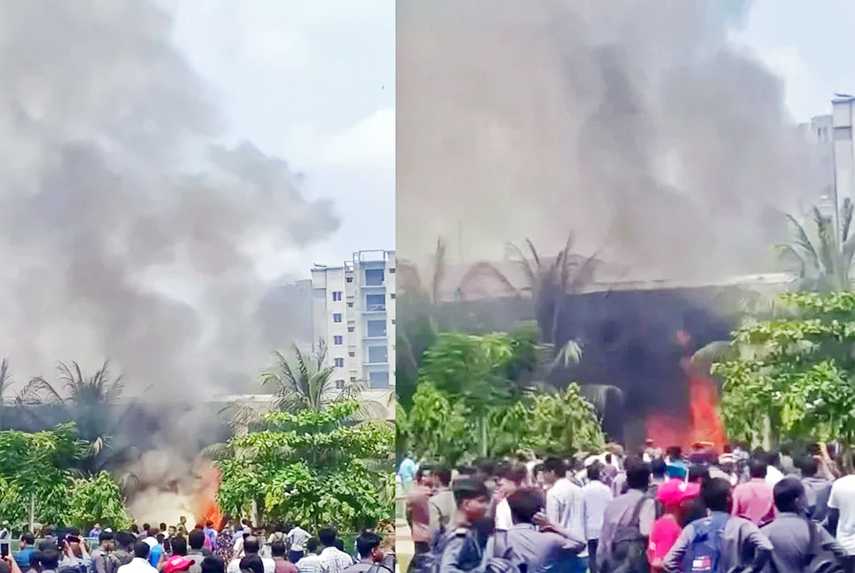
At the time of writing this article, the confirmed death toll from the Milestone School plane crash- a tragic incident involving a military training aircraft and a densely populated school area- stood at 35, according to the latest official reports.
Many others are still lying injured in hospitals, battling pain and uncertainty though many eyewitnesses claim that the actual number of casualties is likely much higher. That is, many people still have doubts and disbelief about the number of injured and dead in this accident.
The Milestone tragedy, unlike routine mishaps, tore many families apart and buried innocent dreams beneath the wreckage. Here some questions naturally arise and some responsibilities are peeking into those questions.
Were the school authorities able to ensure the physical safety of the students in the room where they were assigned to sit for classes? Is it the ill fate of the pilot who failed to control the plane at the crossroads of life and death? Is it the fault of the killer plane, which may have been defective from the start?
Or is it the fault of our conventional state machinery system that has forced the authority concerned to choose the skies of Dhaka, one of the busiest cities in the world, for such a risky training exercise? I have strong belief that no one will take responsibility-not even in the faintest sense. If a proper investigation fails to provide solid evidence through acceptable arguments, public discontent will linger for a long time.
The idea of fighter jet training in the skies of Dhaka seemed a bit incongruous to me at first though I am not an expert on plane crashes. But there are thousands of common people like me who at least believe that, if this training had been conducted in an uninhabited area or a desolate land, the nation would not have to carry the burnt dead bodies of these innocent children on its shoulders.
While searching for expert comments, I came across an article in Prothom Alo on July 23. The analytical article regarding plane crash written by Salahuddin M. Rahmatullah clarifies many unknown issues. He has experience of working as the head of the investigation committee in various plane crashes.
In his speech, he clearly stated that if our fighter jets had had a separate runway, located in a vast field or char area or some other place away from the public locality, then the accident might have been avoided. As an example, he mentioned the abandoned airport in Lalmonirhat and lamented that it was not operational. He also mentioned that the long runways needed to operate fighter jets are in Chattogram and Sylhet.
This expert’s statement clearly shows that in a densely populated city like Dhaka, where there are so many high-rise buildings, many people will lose their lives if an accident occurs during military aircraft training. It denotes that the environment for fighter jet training in the skies of Dhaka is not conducive.
So why is this event being held in such a risky area? Reports indicate that the Chinese-manufactured aircraft model involved in the Milestone School crash had a history of two prior accidents with no civilian casualties as these two accidents were not in populated areas.
Since the same model of aircraft has been involved in accidents before, on what basis or with what reasoning was the Dhaka airspace chosen this time? The responsible authority must have repeatedly thought about what the possible consequences could be if an accident occurred. Students are found saying on social media that planes regularly fly over Milestone School and College, making a loud noise.
This loud noise must be terrifying for the children in the class. Sadly, there was no one then to talk even about the noise pollution. It is unfortunate that in our country, irregularities only come to light when a tragedy occurs.
Any conflict or rumors about the death toll are undesirable. Since the accident occurred just moments before the school dismissal, the class teachers must have the class attendance of the morning hours. The missing can easily be calculated by seeing the presence and absence.
And, only an impartial investigation, one guided by facts and free from institutional bias, can truly uncover the real cause of this tragic accident. Considering the future, training routes should no longer be in the skies of Dhaka. However, if it becomes mandatory, densely populated areas including educational institutions, hospitals and offices must be brought under the ‘no-fly zone’.
We no longer want to see the heartbreaking scenes of a burnt child writhing in pain in the hospital. We no longer want to see the horrific scenes of a seventh-grader walking away from the scene of an accident with a charred body and a bag on his shoulder.
The Bangladesh Air Force, which has taken the oath of ‘Banglar akash rakhibo mukto’ (We will keep the skies of Bengal free), must now equally consider ensuring that the country’s land is protected under the skies of that very oath.
(The writer is Assistant professor and Head Department of English, Ishakha International University).