
Cotton import tax scrapped to boost textile sector
Reza Mahmud :
Bangladesh’s textile industry is showing encouraging signs as the government takes several steps to counter the impact of additional tariffs imposed by the United States.
The US remains the largest market for Bangladesh’s ready-made garment (RMG) exports, which grew robustly by 29.34 per cent to $2.98 billion during January-April 2025, despite ongoing concerns over rising tariffs.
RMG exporters have expressed deep apprehension about the potential impact of the proposed additional tariffs and have called on the government to implement effective measures to mitigate the threat.
In response, the government has initiated multiple efforts, including phased dialogues with US officials to negotiate tariff relief.
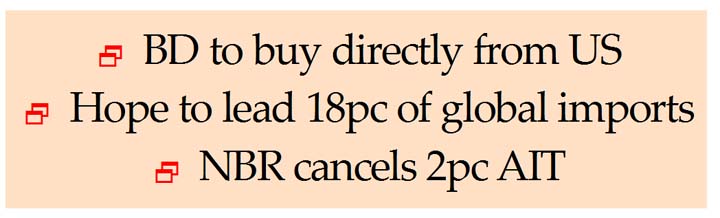
Additionally, the National Board of Revenue (NBR) recently scrapped the 2 per cent advance income tax (AIT) on cotton imports-a significant move following strong opposition from textile manufacturers who warned the tax would burden the $23 billion sector.
The government is also exploring a novel approach to bypass tariff barriers by proposing to source cotton directly from US farmers, potentially reducing reliance on intermediaries and avoiding extra duties.
Former BGMEA Director Mohiuddin Rubel welcomed these initiatives, describing the removal of the AIT on cotton as “a positive development” and noting that direct procurement from US growers could be an effective strategy to overcome tariff challenges.
However, he emphasised that more comprehensive measures are needed to enhance the sector’s competitiveness amid the looming tariff pressures.
The US government has announced plans to impose a 35 per cent additional tariff on Bangladeshi goods effective 1 August 2025, as communicated by former President Donald Trump to Chief Adviser Professor Dr Muhammad Yunus.
To strengthen trade ties, a high-level strategic dialogue took place in Dhaka recently, convened by Bangladeshi-American firm AmeriBangla Corporation.
The session brought together key stakeholders from Bangladesh’s RMG industry, US agricultural representatives, and global trade experts to explore direct sourcing of cotton from US farms.
AmeriBangla CEO Aswar Rahman highlighted the cost benefits and superior fibre quality achievable through direct procurement.
Although US cotton is priced 5-6 cents per pound higher than cotton from West Africa, Brazil, or India, cutting out middlemen could narrow this gap.
Rahman also noted industry concerns over price volatility and stressed the need for long-term price guarantees.
To further promote US cotton, AmeriBangla plans to launch an overseas showroom showcasing apparel made exclusively from US-grown cotton, anticipating shifts in US trade policies favouring domestic producers.
Retired Brigadier General Ali Ahmed Khan served as a senior advisor during the dialogue, which was moderated by Rahman.
These developments, combined with the NBR’s swift rollback of the cotton import tax, reflect Bangladesh’s urgent need to stabilise supply chains and reduce production costs amid a challenging global trade environment.
Meanwhile, an OECD-FAO joint report forecasts Bangladesh to play a leading role in the global cotton trade over the next decade alongside Vietnam.
The Agricultural Outlook 2025-2034 projects steady growth in cotton trade, driven by increasing textile demand in Asia, with trade volumes expected to rise at an average annual rate of 1.6 per cent, reaching 12.3 million tonnes by 2034.
Bangladesh is anticipated to account for 18 per cent of global raw cotton imports by 2034, growing at 2.4 per cent annually.
The report attributes this expansion to the country’s competitive production costs, large cost-effective labour force, and supportive government policies bolstering the export-oriented garment industry.