
Daily battles of Dhaka’s delivery riders
Samiha Chowdhury Shoilee:
City dwellers often rely on outside food and parcel deliveries—not necessarily due to work constraints, but to escape the monotony of daily life. In this context, one familiar sight has quietly become a symbol of perseverance: the delivery man, the unrecognized superhero of urban Bangladesh.
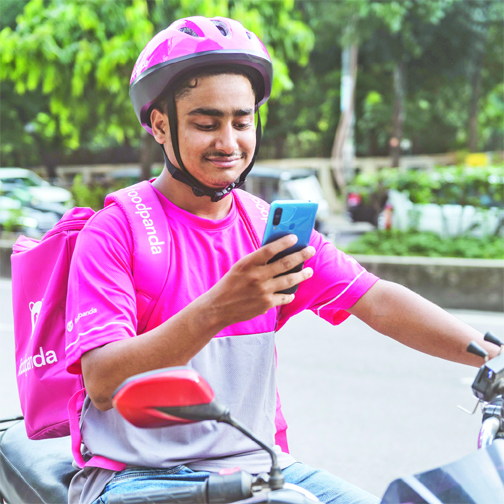
Clad in branded uniforms and carrying oversized delivery bags, these men race against time through the congested streets of Dhaka. Whether under the scorching sun or through stormy weather, they pedal their bicycles or ride motorbikes to ensure timely delivery of parcels. It’s a routine yet remarkable scene across the capital—delivery personnel from companies like Pathao, RedX, and Sundarban Courier Service weaving through traffic, waging a silent war against chaos and delay.
The Bengali poem “Runner” by Sukanta Bhattacharya captures the tireless journey of these messengers, carrying the weight of others’ emotions and responsibilities. Today, although letters have mostly vanished, the spirit of the runner lives on—in the form of today’s delivery workers.
With the rise of e-commerce and digital platforms, deliveries have become instant. A single tap on a phone screen can bring food, gadgets, or clothing to your doorstep within hours. Yet, we rarely stop to appreciate the human behind the delivery—a man often exhausted, underpaid, and undervalued.
Delivery companies like Foodpanda, Pathao, SA Paribahan, RedX, eCourier, and Sundarban Courier operate throughout Bangladesh, but their treatment of delivery agents often lacks compassion. Payment structures vary, but most fail to provide fair wages or job security. These jobs come with long hours, mental and physical fatigue, and meager earnings.
Shafikul Alam, a Foodpanda delivery worker, shared his experience with The New Nation. “I’ve been working here for nearly six years, but there’s been no salary increment. They pay 30–40 taka per delivery. On average, I earn 400 taka daily, and if I’m lucky, it goes up to 700. My monthly income is around 12,000 taka, which is not enough anymore,” he said, frustration evident in his voice.
Foodpanda calculates salaries based on delivery distance and time. Pathao, by contrast, pays 40 to 60 taka per delivery, and riders can earn up to 1,000 taka daily, with a monthly income ranging between 15,000 and 20,000 taka. Steadfast pays a fixed 10,000 taka monthly, plus 20 taka per delivery. Paperfly uses a performance-based system: those who complete 95% of their tasks receive 16 taka per delivery, while those under 85% earn just 7 taka per order.
“In a day, I handle 10–12 deliveries,” Shafikul added. “But the hardest part is making sure each order reaches the customer on time, especially in this city where traffic jams are a constant. Sometimes customers lose patience and behave rudely, not realizing what we go through.”
(Samiha is working as an Internee Journalist at The New Nation)