
BNP emerges as youth favourite in Sanem poll
Staff Reporter :
A recent nationwide survey conducted by the South Asian Network on Economic Modeling (Sanem) indicates that a significant proportion of Bangladeshi youth view the Bangladesh Nationalist Party (BNP) as the leading contender in the forthcoming 13th national parliamentary election.
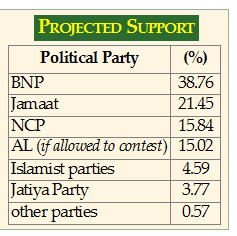
According to the survey findings, 38.76 per cent of respondents predicted a BNP victory, reflecting a notable shift in youth political sentiment in the aftermath of last year’s mass uprising that resulted in the fall of the Awami League government.
The survey, titled “Youth in Transition: Navigating Jobs, Education, and Changing Political Scenario Post July Movement,” was presented on Sunday during a roundtable discussion held at the Brac Centre Inn in Dhaka.
While the BNP emerged as the clear frontrunner, the Islamist party Jamaat-e-Islami is projected to secure 21.45 per cent of the vote, followed by the newly formed National Citizen Party (NCP) with 15.84 per cent. Other Islamist groups collectively account for an estimated 4.59 per cent.
Though trailing the BNP, political analysts suggest that a possible electoral alliance between Jamaat, the NCP, and other like-minded parties-currently under discussion-could potentially mount a strong challenge to BNP’s dominance.
Despite its ousting, the Awami League still retains a measure of support among the youth. The survey estimates that, if permitted to contest, the party would receive 15.02 per cent of the vote. Meanwhile, the Jatiya Party is projected to gain 3.77 per cent, with other political entities collectively receiving 0.57 per cent.
While releasing the data, Dr Selim Raihan, Executive Director of Sanem, advised caution in interpreting the results. “Given the relatively small sample size, the survey does not reflect a nationally representative view,” he stated. “However, it offers a snapshot of the opinions held by those who participated.”
The survey interviewed 2,003 individuals, with 1,935 (96.6 per cent) responding to the political preference section.
On expectations surrounding the upcoming election, 40.89 per cent of respondents said they were moderately optimistic that the polls would be free and fair. Another 27.91 per cent described themselves as very optimistic, while 11.93 per cent expressed full confidence. In contrast, 13.23 per cent reported being slightly optimistic, and 6.04 per cent stated they were not optimistic at all.
The data also revealed strong voter engagement, with 76.78 per cent of respondents indicating their intention to vote.
Only 4.14 per cent said they would not vote, and 5.09 per cent were undecided. Additionally, 13.98 per cent of respondents said they were not eligible to vote.
The survey underscores a growing political awareness among the country’s youth, who appear increasingly engaged and positioned to play a pivotal role in determining Bangladesh’s future political direction.