
Nationwide student unrest after quota verdict
NN Online:
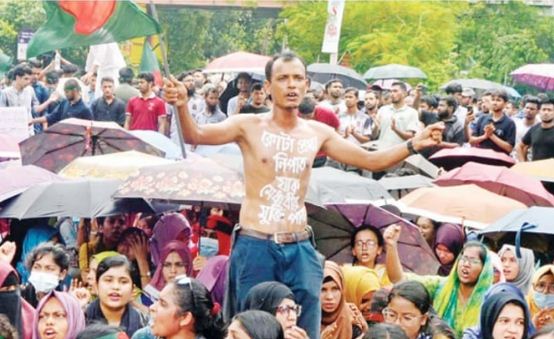
Students across the country erupted in massive protests on July 4, following the Appellate Division’s decision to uphold the High Court verdict that reinstated the quota system in government jobs. The protests were triggered as the Chamber Court set the day for hearing the government’s appeal against the High Court’s ruling, but the judgment ultimately frustrated students and intensified the movement.
In response, student leaders announced a fresh three-day protest programme, including countrywide demonstrations on July 6 and a nationwide student strike with class and exam boycotts on July 7, demanding full implementation of the 2018 circular that abolished quotas in public service recruitment.
Despite heavy rain, hundreds of students from various institutions gathered in Dhaka and blocked the Shahbagh intersection for six hours, staging a sit-in under the banner of the Anti-Discrimination Student Movement. Similar protests took place at Jahangirnagar, Rajshahi, Chittagong, Khulna, Barishal, Cumilla, Islamic University, and Sher-e-Bangla Agricultural University, with students blocking highways and city intersections.
At Dhaka University, students marched from residence halls and campus landmarks to Shahbagh, eventually announcing further protests from the Raju Memorial Sculpture after ending the day-long blockade around 6:00 PM.
Addressing the crowd, Nahid Islam, a key coordinator of the movement, declared the next steps:
July 5 (Friday): Online and offline publicity campaigns on campuses nationwide.
July 6 (Saturday): Simultaneous demonstrations at all universities and colleges at 3:00 PM.
July 7 (Sunday): Nationwide student strike with boycott of all classes and exams.
Field-level programmes for Sunday would be announced during Saturday’s events, he added.
Nahid criticized the judicial decision, saying, “In 2018, the executive abolished the quota system through a circular. Now, the judiciary has reinstated it. This reflects a complete disconnect between state organs, and the students are being made to suffer for it.”
He also accused activists from the ruling party’s student wing, Bangladesh Chhatra League (BCL), of attempting to prevent students from joining the protest by locking dormitory gates and confining students in “guest rooms.” Protesters reportedly broke the locks to free their peers and join the demonstration.
Protests were also reported from:
Jahangirnagar University: Students blocked the Dhaka-Aricha highway.
Jagannath University: Demonstrators shut down Ray Shaheb Bazar intersection in Old Dhaka.
Chittagong University: Students blocked the Chattogram–Khagrachhari highway.
Rajshahi University: Demonstration on the Dhaka–Rajshahi highway.
Khulna University: Blockade at Khulna’s Zero Point.
Islamic University: Protesters occupied the Kushtia–Khulna highway.
Cumilla University: Demonstration on the Dhaka–Chattogram highway.
SAU students: Gathered at Agargaon intersection in the capital.
The student movement gained widespread traction on social media platforms, particularly through the Facebook and Telegram groups titled “Quota Punorbohal Chaina” (No to Quota Reinstatement), which became central to coordinating activities and spreading updates.
The current wave of protests began after the High Court, on June 5, declared illegal the government’s 2018 circular that had scrapped all quotas, including the 30% allocation for freedom fighters’ descendants. The verdict reignited nationwide debate and prompted the government to file an appeal, which the students hoped would reverse the High Court’s ruling.
Instead, the Appellate Division’s refusal to stay the ruling has fueled a renewed protest wave, now rapidly expanding into a unified nationwide movement pressing for reform of the quota system in government recruitment.