
Infrastructure slowdown sees growth drop to 1.1pc
Staff Reporter :
The Bangladeshi construction sector is set to experience a significant deceleration in growth, with projections indicating a slowdown from 3.4 per cent in real terms in 2024 to just 1.1 per cent in 2025.
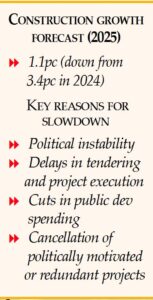
This outlook, highlighted in the newly released Bangladesh Construction Market Size, Trends, and Forecasts by Sector to 2029 (H1 2025) by ResearchAndMarkets.com, attributes the downturn to sustained political instability and the scaling back of the country’s Annual Development Programme (ADP).
In March 2025, the National Executive Committee (NEC) revised the ADP allocation for FY2024-25 (July 2024-June 2025) to TK. 2.2 trillion (USD 17.6 billion), an 18.5 per cent reduction from the original budget and 11.8 per cent lower than the previous year’s revised figure.
Notably, allocations for the transport and communication sector and the power sector were slashed by 31.7 per cent and 21.7 per cent, respectively. The revisions come amid delays in tendering processes, rising project costs, and the cancellation of numerous projects initiated by the previous Awami League government.
In December 2024, the interim government cancelled 67 infrastructure projects and subsequently axed an additional ten development initiatives valued at TK. 50.8 billion (USD 407.4 million), citing redundancy and political motivations. In January 2025, a task force report revealed that eight major infrastructure projects have encountered significant delays due to rising construction costs, with their combined valuations rising from TK. 1.4 trillion (USD 11.2 billion) to TK. 2.3 trillion (USD 18.6 billion).
Compounding the sector’s challenges, US President Donald Trump’s suspension of foreign aid from the United States Agency for International Development (USAID) in January 2025 triggered the immediate halt of over 100 projects valued at TK. 68.6 billion (USD 550 million). Further uncertainty has been introduced by reciprocal measures announced by the US government in April 2025, which are currently paused for a 91-day review period.
Despite these near-term headwinds, the outlook for Bangladesh’s construction industry from 2026 to 2029 is more optimistic. The sector is expected to rebound with an average annual growth rate of 6.3 per cent, underpinned by renewed investment in energy, transport, industrial, and telecommunications infrastructure.
In December 2024, Bangladesh secured TK. 149.6 billion (USD 1.2 billion) in development financing for clean energy, healthcare, and water infrastructure projects. This, alongside the government’s target to raise power generation capacity from 25,826MW in 2023 to 60,000MW by 2041, is expected to support long-term sectoral growth.
Efforts to expand renewable energy are also underway, with plans to add 3,600MW of new capacity by 2030. In late March 2025, the Bangladesh Power Development Board (BPDB) issued a tender for 14 solar power projects totalling 2.7GW in capacity.
Rail infrastructure will also receive a significant boost under the Bangladesh Railway Master Plan (2016-2045), which includes the construction of 798.1km of new railway lines, 897km of dual gauge tracks, and nine new railway bridges.
While the sector faces immediate constraints, analysts remain hopeful that structural reforms, improved governance, and international support will drive a robust recovery in the medium term.