
New tax measures trigger inflation worries
Staff Reporter :
Economic experts have raised concerns that the government’s recent increase in advance tax (AT) for importers – excluding industrial sectors – could contribute to rising inflation and place further strain on consumers.
The warning came during a post-budget discussion held in Dhaka on Monday, titled “Budget Insights: Challenges and Opportunities Ahead”, jointly organised by the Metropolitan Chamber of Commerce and Industry (MCCI) and the Policy Research Institute (PRI).
Delivering the keynote address, PRI Chairman Dr Zaidi Sattar cautioned that the new fiscal measures, aimed at offsetting revenue losses from VAT evasion, could have unintended inflationary consequences.
In the proposed national budget for FY2025-26, the government raised the AT rate for commercial importers from 5 per cent to 7.5 per cent, while reducing the rate for industrial importers of raw materials from 3 per cent to 2 per cent-a move designed to safeguard industrial production. However, experts warn that this could raise prices in other sectors and burden ordinary consumers.
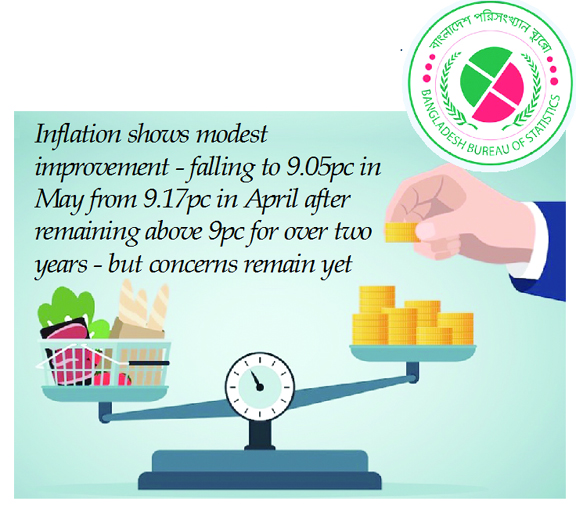
Although recent inflation figures show modest improvement-falling to 9.05 per cent in May from 9.17 per cent in April after remaining above 9 per cent for over two years-concerns remain. Food inflation eased slightly to 8.59 per cent, and non-food inflation declined to 9.42 per cent, according to the Bangladesh Bureau of Statistics.
Special Assistant to the Chief Adviser, Anisuzzaman Chowdhury, who attended the event as chief guest, acknowledged the budget’s pro-business approach, while noting its shortcomings. He stressed the importance of reducing reliance on foreign borrowing, which he said often comes with policy conditions, and called for reforms to boost domestic revenue and foreign investment.
Dr Sattar emphasised the importance of improving national productivity and competitiveness to diversify the economy, drive growth, and create employment. He advocated for a rationalised tariff structure paired with more efficient income tax and VAT collection as part of broader revenue reform efforts.
He also called for urgent improvements in tax policy and administration to strengthen fiscal sustainability.
Addressing growing fiscal pressures, Sattar noted that rising budget deficits-largely financed by borrowing from banks and the central bank-have contributed to inflation and the weakening of the local currency. He warned against over-reliance on Treasury bills, which raise debt servicing costs and limit private sector access to credit.
To mitigate these risks, he recommended capping domestic bank financing at 1 per cent of GDP and meeting the remainder of financing needs through external sources.
He further proposed phasing out subsidies for exports and remittances, arguing that such incentives distort market rates and conflict with efforts to maintain a flexible, market-based exchange rate regime.
MCCI Presicent Kamran T Rahman echoed these views, warning that expanded government borrowing under the Finance Ordinance 2025 could crowd out private sector investment and contribute to further inflation, ultimately harming consumers.