
Demands, protests hold Dhaka hostage
Abu Jakir :
Since the interim government took office, a wave of protests has gripped the country, with roads and highways being suddenly blocked, bringing traffic to a standstill.
Justified or not, the streets have become the ultimate battleground for pressing demands.
herefore, frustration is mounting among ordinary citizens, who now expect to be stuck in hours-long traffic whenever they leave their homes.
Whenever protests erupt, daily life is severely disrupted. The situation has become so chaotic that the Dhaka Metropolitan Police (DMP) has advised city residents to call 999 to check if their intended route is operational.
Since the fall of the Awami League government on 5 August, public order has deteriorated, placing law enforcement in a challenging position.
Traffic police were absent from the streets for several days, but after the interim government assumed power, various groups-including professionals, students, and workers-took to the streets to voice their demands.
Analysts warn that some groups may be exploiting the situation for personal gain by causing widespread public inconvenience. Authorities are urged to investigate whether vested interests are manipulating these protests.
Media reports indicate that in January alone, the Dhaka-Tangail and Dhaka-Mymensingh highways were blocked 11 times due to various demands. In the past 28 days, there have been 16 major roadblocks in Dhaka alone, with over a hundred demonstrations occurring nationwide.
On 26 August, the Dhaka Metropolitan Police issued a public notice banning all gatherings around the Bangladesh Secretariat and the Prime Minister’s residence, Jamuna. However, protesters have ignored the directive, continuing their demonstrations near the Secretariat despite warnings.
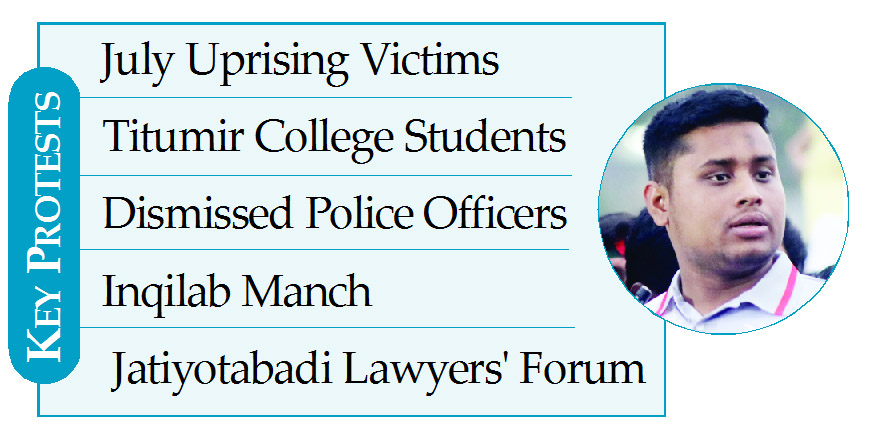
Titumir College Protest: Students of Government Titumir College blocked the Mohakhali road on Sunday, demanding the institution be upgraded to a university. The blockade, starting at 11:50 AM, brought traffic to a halt. Despite government assurances, students vowed to continue their protests.
Education adviser Dr Wahid Uddin Mahmud dismissed their demand, stating that the government is considering merging seven colleges into a single university-like institution. He emphasised that the interim government is focused on reforms rather than fulfilling demands.
July Uprising Victims’ Protest: Several individuals injured in the July mass uprising staged a demonstration in front of the National Institute of Traumatology and Orthopaedic Rehabilitation (Pangu Hospital), demanding rehabilitation, the cancellation of the category-based treatment system, and improved medical care.
Shortly after, injured protesters blocked roads near Agargaon’s Revenue Building, the 250-bed TB Hospital, and the National Institute of Ophthalmology, leading to severe traffic congestion.
Dismissed Police Officers’ Protest: Former police officers who lost their jobs during the Awami League government gathered at the High Court Mazar, demanding reinstatement. They claim political victimisation led to their dismissal.
Inqilab Manch Protest: The group announced a march from Raju Sculpture to the Ministry of Home Affairs, demanding the resignation of the Home Affairs Adviser over his failure to ensure justice for victims of the July massacre.
Jatiyotabadi Lawyers’ Forum Ultimatum: The forum issued a demand for the removal of Hasina loyalists from the administration.
The increasing frequency of protests has significantly affected public life. Patients, emergency service users, and businesses are among the worst affected. Many citizens have called for a law to ban rallies in key areas of Dhaka.
A frustrated commuter, Afzal Hossain, said, “I took a bus from Mirpur to Shahbagh, but upon reaching Agargaon, the road was blocked. Every other day, there’s some protest here. Dhaka has turned into a city of protests.”
Public transport drivers are also struggling. Fazal Mia, a bus driver, stated, “Passengers left when they saw the road was blocked, but we have nowhere to go. I’ve been stuck here since morning.”
Hasnat Abdullah, coordinator of the Anti-Discrimination Student Movement, told the media, “The previous authoritarian government was overthrown through public movement. Many suffered under that regime. The interim government is working to address inequalities, but people need to allow some time for reforms.”
With protests continuing to paralyse the capital, concerns are growing about how long this unrest will persist – and at what cost to the nation.