
No price hike during Ramadan, reassures Bashir
Staff Reporter :
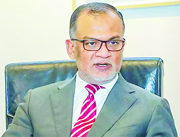
Commerce Adviser Sk Bashir Uddin has assured that the prices of essential commodities will remain stable during the upcoming month of Ramadan.
Speaking at a policy conclave titled “Reasonable Pricing of Food Items: Exploring Market Supervision Strategies,” held at a local hotel in Dhaka on Sunday, he emphasised that the country’s import systems and stock reserves are adequate to meet demand during the holy month. The event was organised by The Daily Bonik Barta.
“InshaAllah, there will be no shortages of essential items such as oil, sugar, chickpeas, and dates in the market,” he stated.
Despite rising international commodity prices, the adviser noted that local market conditions suggest prices should actually decline. “I see no reason for prices to increase.
Today, we have engaged in in-depth discussions about what reasonable food prices should be, and both short-term and long-term strategies will be implemented to bring these ideas to life.”
He also underscored the importance of policy reforms to better support consumers. Highlighting the role of regulatory bodies in ensuring fair market practices, he pointed to the Competition Commission, the Directorate of Consumer Rights Protection, and the Trading Corporation of Bangladesh (TCB). Additionally, he noted that the Tariff Commission and the National Board of Revenue (NBR) are actively working to make the market more consumer-friendly.
He urged local producers, importers, and traders to contribute to fostering a more competitive market.
Discussing rice bran oil-a commodity known for its health benefits-Bashir Uddin revealed that around 500,000 to 600,000 tonnes of this oil were previously exported to India.
However, the government has imposed a 25% regulatory tax to discourage exports. “If this oil is redirected to the local market, it will help stabilise oil prices further. The only real difference between bottled and bulk oil is the price,” he remarked.
Amid concerns over a shortage of bottled soybean oil, the adviser shared his personal experience, revealing that he has been using loose soybean oil for the past three weeks.
“For the last three weeks, my family and I have been using non-brand, loose soybean oil because, apart from the price, there is no difference between loose and packaged oil. The price of bottled oil is unnecessarily high,” he commented at the Dhaka discussion.
Reflecting on his childhood, he recalled, “I remember my father and other family members bringing home loose oil.
To me, it seems both more environmentally friendly and cost-effective.”
He also announced that the government is working to strengthen the independence of the Competition Commission to promote a fair and competitive market.
“Our policies have largely favored the wealthy rather than the common people. Over the past 15 years, large-scale investments have been minimal, leading to stagnation in employment opportunities. Without increased investment, how can tax revenues grow?” he questioned.
Criticizing the banking sector, he argued that banks have become “criminal institutions” and lamented the decline of Islamic banks and the TCB. “According to TCB records, 4.3 million fake beneficiaries have been identified, and this requires further investigation,” he added.
Dr. Khondkar Golam Moazzem, Research Director at the Centre for Policy Dialogue (CPD), delivered the keynote address. Other speakers at the event included Mohammad Abdur Rahman Khan, Chairman of the National Board of Revenue; former Jahangirnagar University professor and economist Anu Muhammad; Mohammad Abdur Rahim Khan, Secretary of the Ministry of Commerce (routine duties); national committee leader Sergis Alam; and Umama Fatema, chief coordinator of the Anti-Discrimination Student Movement.