
All The Prime Minister's Men: Hasina tried to silence media via UK barrister
Reza Mahmud :
Deposed dictator of Bangladesh Sheikh Hasina reportedly sought assistance from one of Britain’s leading barristers, Desmond Browne KC, in an effort to suppress media scrutiny of her administration’s alleged scandals, recently revealed documents suggest.
According to The Sunday Times, the British barrister provided counsel to Hasina’s government following a damaging exposé on state corruption.
The matter came to light when a crumpled document was discovered in Sheikh Hasina’s bedroom at her ransacked former residence, Ganobhaban, in Dhaka.
The document detailed Browne’s agreement to meet with officials.
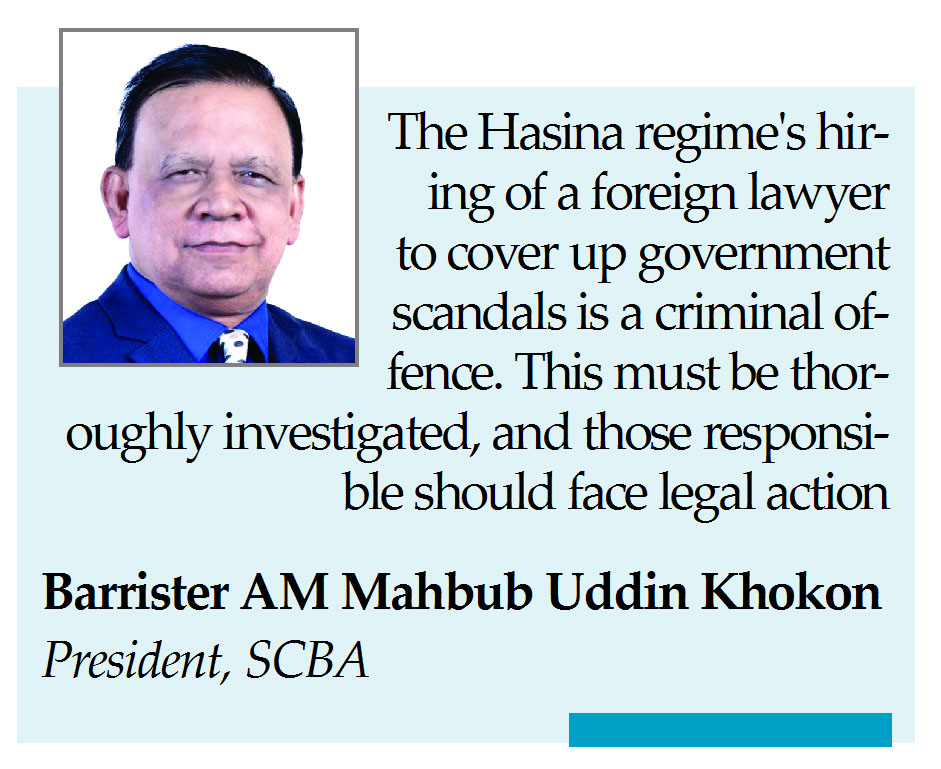
When approached, Bangladesh Supreme Court Bar Association (SCBA) President Barrister AM Mahbub Uddin Khokon told The New Nation on Sunday, “The Hasina regime’s hiring of a foreign lawyer to cover up government scandals is a criminal offence.
This must be thoroughly investigated, and those responsible should face legal action.”
He further emphasised that officials from the Bangladesh High Commission in London should also be held accountable, as concealing government misconduct was beyond their remit.
As per The Sunday Times report, officials from the Bangladesh High Commission in London contacted Browne in February 2021. Both Browne and a solicitor subsequently provided advice to Hasina’s representatives the following month.
The controversy erupted after Al Jazeera aired the documentary “All The Prime Minister’s Men,” which exposed corruption within the Bangladeshi state.
The documentary featured footage of Bangladesh’s former army chief General Aziz Ahmed’s brother admitting to using police and paramilitary forces to abduct rivals and accept substantial bribes.
The exposé, which garnered 10 million views on YouTube, earned awards and led to US President Joe Biden banning Aziz Ahmed and his brother from entering the United States. Hasina’s government dismissed the documentary as “false, defamatory, and politically motivated.”
The fallout was intense. Zulkarnain Saer Khan, a whistleblower, reported that his brother was beaten with iron bars shortly after the documentary aired. Other contributors fled the country, fearing for their safety.
Documents revealed that Hasina’s government had considered taking legal action against Al Jazeera and British journalist David Bergman, who contributed to the documentary.
Bergman, a long-time critic of Hasina’s government, had already left Bangladesh after being denied a visa. Officials allegedly made unfounded claims about Bergman and even considered arresting him, though he later stated he was unaware of these developments.
Browne, a respected barrister and former chairman of the Bar Council, agreed to assist the Bangladesh High Commission during a virtual meeting on 10 February 2021. However, he made it clear that a solicitor would need to formally instruct him.
Browne recommended Jeremy Clarke-Williams, a reputation management lawyer from the London firm Pennington Manches Cooper.
Hasina’s representatives met with Clarke-Williams on 17 February, arguing that the documentary lacked substance but had significantly damaged her reputation.
They explored whether the Bangladeshi government, the army, or individuals like General Aziz could pursue defamation claims.
Ultimately, Bangladesh decided against filing a lawsuit in the UK. Instead, the government sought to pressure YouTube and Facebook to remove the documentary. Both platforms refused, even after a Dhaka High Court ruling in the government’s favour.
The documentary remains publicly accessible.
Sheikh Hasina was deposed during a student-led uprising last year and fled to India. Protesters stormed her residence, where thousands of documents, photographs, and artefacts are now under police protection.
The documents detailing Browne’s and Clarke-Williams’ involvement were discovered in Hasina’s private quarters, covered in dust.
When contacted for comment, Browne cited the barrister’s “cab rank” rule, which obliges lawyers to accept cases regardless of the client’s reputation. He acknowledged the initial meeting and advice but clarified that no further correspondence or legal action ensued. Clarke-Williams did not respond to requests for comment.
This case has reignited concerns about “libel tourism,” where foreign entities use UK courts to suppress criticism. Despite legislative reforms, the UK remains a preferred jurisdiction for such cases due to its claimant-friendly legal system.